
Learning to appreciate the world through Indigenous ways of knowing and seeing is a lifelong process which I, as a white person, will never master. None the less, I’m so happy to have gone on this journey starting with Katilvik and Idlenomore, to my classmate Janice O’s tobacco teachings, RW Kimmerer’s book, and further on into the future.
I feel that I’ve really broaden my scope of ‘learning’ and expanded my comfort zone as well. Reading Braiding Sweetgrass, which so expertly weaves both biological and Indigenous perspectives, and listening to elders like Bertha Skye share their knowledge, has given me the opportunity to hear from true experts. Living in this age of reconciliation, decolonisation, and global communication is truly a gift. While basic searching can give you a sense of what two eyed seeing means, only by listening to people who truly live this was I final able to fully connect to it. I’m feeling much more confident in my ability to learn from knowledge keepers and incorporate Indigenous knowledge and practices into my own teaching practice.
Driving through the Yukon between Whitehorse and Carcross Tagish, I felt the beauty of the land and the beauty of the people. The was art on buildings, public and not, showing the influence of local artistic traditions. The bold colours, shapes inspired by wood carving, and strong themes of nature. The peoples values and vision were stamped clear for all to see, giving a sense of place as well as pride.
What was interesting to me was that when I went to double checking locations in google maps, most of these were not photographed. They must be newer than 2005, and indeed some of the buildings even were not yet present. I’m impressed and lucky to see such active efforts and creativity in those communities.
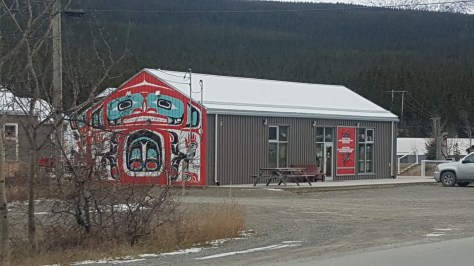
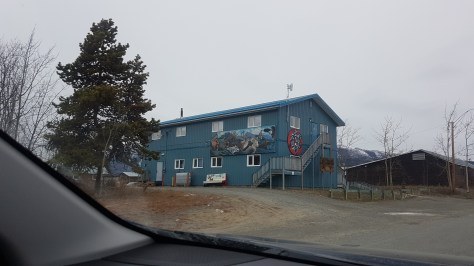
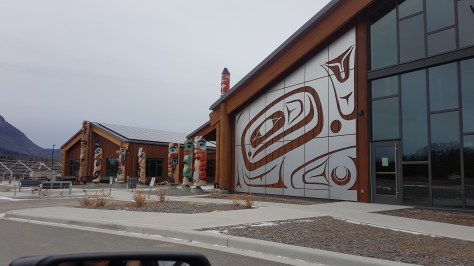
I was also amazed to learn, from another classmate, about Carcross’ incredible Science 10 program. The video below is from the two eyes seeing Facebook page which presents lessons teaching through both Indigenous knowledge and Western Knowledge traditions. This reinforced to me that community, learning, and art support and feed one another. This community really inspired me and I hope that I’ll be able to properly visit and learn from local peoples when this pandemic is over.
I was also lucky enough to visit the North End Gallery in Whitehorse this fall. Although I was not allowed to take picture of my favourites, I enjoyed spending over two hours in the small gallery. There was a mix of carving, prints, decorations, and more from various Indigenous and non-Indigenous artists to view. Some of my favourites were Amber Church, Emma Barr, Richard Shorty, and Mark Preston to name a few.
I was able to see, and sometimes feel, the craftsmanship and vision that went into each piece, creating beauty and inciting reactions. I was better to understand the descriptions from the Katilvik website regarding bold colours, representing nature, and loose delineation between subject and setting.

Raven brings Salmon by Eugene Alfred 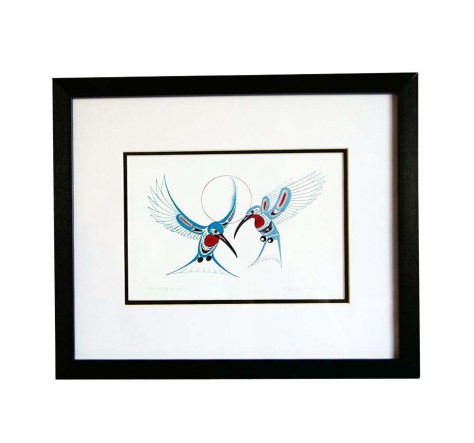
Hummingbirds By Richard Short 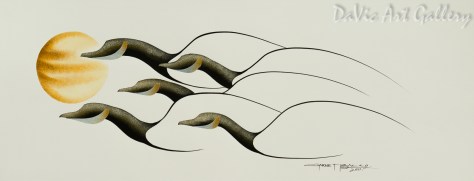
Family Flight by Garnet Tobacco 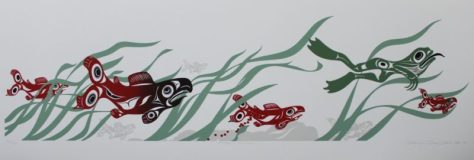
Fragile Balance by Mark Preston
To finally do my own project, I had considered doing lacemaking. It would not be appropriate for me to work from an Indigenous art tradition, as it is not my own, so I tried to find one from my own culture. I settled on lacemaking, I remember doilies, Madeline novels, and historic dress from Western Europe so I wanted to try my hand at the craft. As you’ll at the 0:50 second mark below, that was biting off more than I could chew. I found further crafts of needle lacemaking, and tatting which were more common as handicraft than artisanal bobbin lacemaking but I still need more practice.
What I was struck by was the number of older people venturing onto the internet explicitly to share there own traditional techniques. Many of the terms they used where familiar to me from other contexts (whip around stitch) and the patterns were also not new either. These crafts are fading even from European cultures, presumable in part because they’re not commercially viable or entertaining enough to learn. But listening to people who sound and look so much like my family sharing the story of so many traditional objects (wedding dresses, christening gowns, décor etc.) gave me a great sense of connection.
The grief that must be felt by so many communities who lost all of that is staggering. I truly believe that we as educators, and as Canadian citizens, must do everything we can to support the revitalisation of FNIM cultures, traditions, and communities that Indigenous people are undertaking across the country.
This includes both historic crafts and present day efforts as well. We must also support political and young art such as the art from Idle No More. The Indigenous people of Canada are living, breathing, and here as their stories continue on.
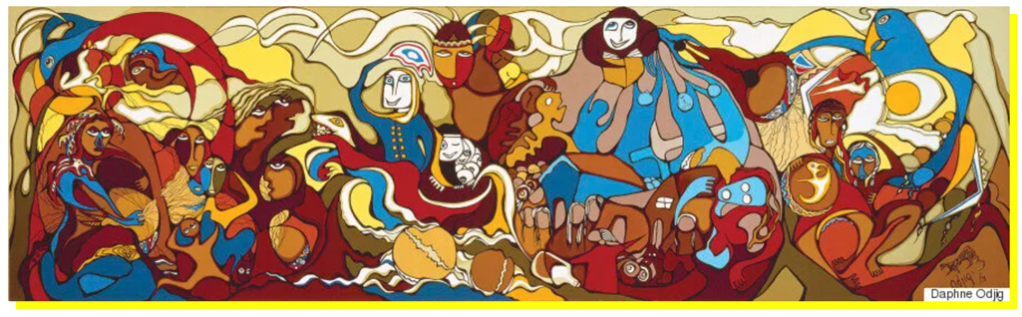
 Baumann Teaching