I tried to present without a formal presentation, focusing on my visual products and oral narration but it was nerve-racking at the start. It was a test to stay focused and clear but I enjoyed the fluidity and felt more energised while presenting.
Presenting the various aspects of my learning was hard, especially trying to explain the sources of my understanding without common context while still driving towards a point.
While presenting I learned the importance of clear background and objective. One classmate didn’t know I wasn’t an art specialist until they asked afterwards, so I imagine some of my intention was missed because of my vagueness.
Presentation of Learning
Objective: I wanted to broaden the scope of my perspective and teaching practice. Background: 1) I graduated awhile ago, my teachers were innovative but most lessons and assessments were lecture and essay/test focused. 2) My family enjoyed creative activity but the expectation was to strive for a financially safe career, art and other endeavors would have required significant artistic talent. I did not know what to do with the Katilvik Inuit art website and I did not like that limitation. 3) My career in ecology and microbiology focused on quantifying nature into data. This data was then analysed to remove any irregularities and confidence assessed before even proposing and theory or explanation. Problem: In my experience, most people love scientific trivia and notice patterns of phenomena. Also, most people don’t think they are good at science and they can’t see it in their everyday life. These concepts seem to be dissonant and I’d like to bring more people’s experiences and ‘science into harmony. Proposed Solutions: 1) By incorporating broader ways of knowing and relating to the world around us I can approach teaching scientific concepts with greater diversity and relevancy. 2) By increasing my experience and confidence with oral history, storytelling, Indigenous traditions, and visual art I will be better able to incorporating these elements into my planning and meaningfully assessment them for my students. 3) By striving to improve my understanding, expand my skill set, and evaluate myself I am progressing as a lifelong learner. Hopefully, starting these habits now will hopefully continue those habits through out my professional practice and beyond. 4) By exhibiting openness to different perspectives, methodology and conventions (language etc.) I can invite more people to engage with the world around them and science with confidence.
Learning to appreciate the world through Indigenous ways of knowing and seeing is a lifelong process which I, as a white person, will never master. None the less, I’m so happy to have gone on this journey starting with Katilvik and Idlenomore, to my classmate Janice O’s tobacco teachings, RW Kimmerer’s book, and further on into the future.
I feel that I’ve really broaden my scope of ‘learning’ and expanded my comfort zone as well. Reading Braiding Sweetgrass, which so expertly weaves both biological and Indigenous perspectives, and listening to elders like Bertha Skye share their knowledge, has given me the opportunity to hear from true experts. Living in this age of reconciliation, decolonisation, and global communication is truly a gift. While basic searching can give you a sense of what two eyed seeing means, only by listening to people who truly live this was I final able to fully connect to it. I’m feeling much more confident in my ability to learn from knowledge keepers and incorporate Indigenous knowledge and practices into my own teaching practice.
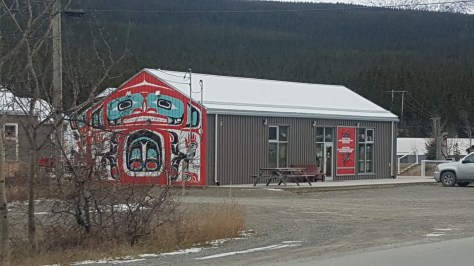
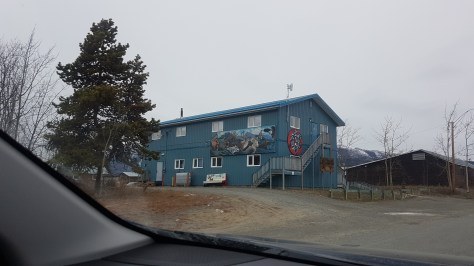
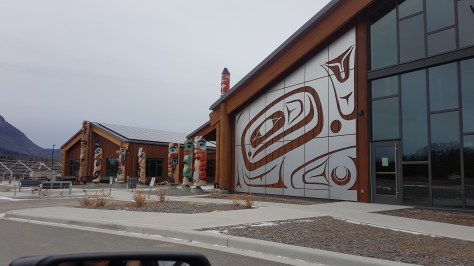
Driving through the Yukon between Whitehorse and Carcross Tagish, I felt the beauty of the land and the beauty of the people. The was art on buildings, public and not, showing the influence of local artistic traditions. The bold colours, shapes inspired by wood carving, and strong themes of nature. The peoples values and vision were stamped clear for all to see, giving a sense of place as well as pride.
What was interesting to me was that when I went to double checking locations in google maps, most of these were not photographed. They must be newer than 2005, and indeed some of the buildings even were not yet present. I’m impressed and lucky to see such active efforts and creativity in those communities.
Carcross Visitors Centre
Carcross Tagish Learning Centre
I was also amazed to learn, from another classmate, about Carcross’ incredible Science 10 program. The video below is from the two eyes seeing Facebook page which presents lessons teaching through both Indigenous knowledge and Western Knowledge traditions. This reinforced to me that community, learning, and art support and feed one another. This community really inspired me and I hope that I’ll be able to properly visit and learn from local peoples when this pandemic is over.
A new science class is being held outdoors near Carcross, YT. It incorporates Indigenous culture and traditional knowledge — and offers the equivalent of a Grade 10 credit in just 10 days.
I was also lucky enough to visit the North End Gallery in Whitehorse this fall. Although I was not allowed to take picture of my favourites, I enjoyed spending over two hours in the small gallery. There was a mix of carving, prints, decorations, and more from various Indigenous and non-Indigenous artists to view. Some of my favourites were Amber Church, Emma Barr, Richard Shorty, and Mark Preston to name a few.
I was able to see, and sometimes feel, the craftsmanship and vision that went into each piece, creating beauty and inciting reactions. I was better to understand the descriptions from the Katilvik website regarding bold colours, representing nature, and loose delineation between subject and setting.
Raven brings Salmon by Eugene Alfred
Hummingbirds By Richard Short
Family Flight by Garnet Tobacco
Fragile Balance by Mark Preston
To finally do my own project, I had considered doing lacemaking. It would not be appropriate for me to work from an Indigenous art tradition, as it is not my own, so I tried to find one from my own culture. I settled on lacemaking, I remember doilies, Madeline novels, and historic dress from Western Europe so I wanted to try my hand at the craft. As you’ll at the 0:50 second mark below, that was biting off more than I could chew. I found further crafts of needle lacemaking, and tatting which were more common as handicraft than artisanal bobbin lacemaking but I still need more practice.
Belgian Bobbin Lace Making Demonstration
What I was struck by was the number of older people venturing onto the internet explicitly to share there own traditional techniques. Many of the terms they used where familiar to me from other contexts (whip around stitch) and the patterns were also not new either. These crafts are fading even from European cultures, presumable in part because they’re not commercially viable or entertaining enough to learn. But listening to people who sound and look so much like my family sharing the story of so many traditional objects (wedding dresses, christening gowns, décor etc.) gave me a great sense of connection.
The grief that must be felt by so many communities who lost all of that is staggering. I truly believe that we as educators, and as Canadian citizens, must do everything we can to support the revitalisation of FNIM cultures, traditions, and communities that Indigenous people are undertaking across the country.
This includes both historic crafts and present day efforts as well. We must also support political and young art such as the art from Idle No More. The Indigenous people of Canada are living, breathing, and here as their stories continue on.
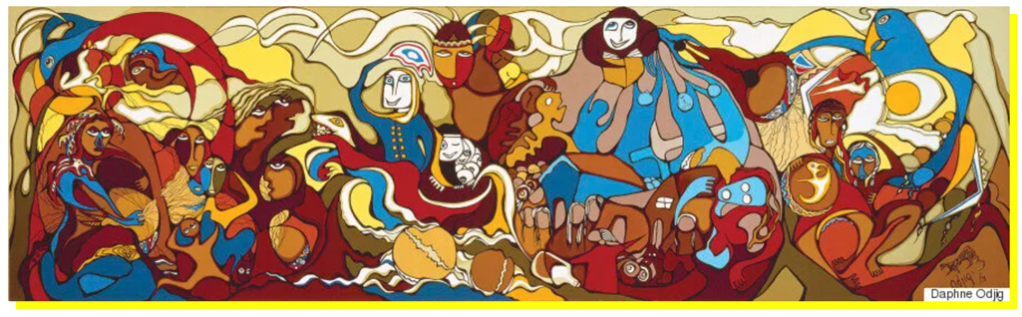
“The Indian in Transition” is a mural that was commissioned by the Canadian Museum of Civilization. It reflects the history of Indigenous people from before contact with Europeans, through centuries of colonization. A mythic Thunderbird watches history unfold from above.
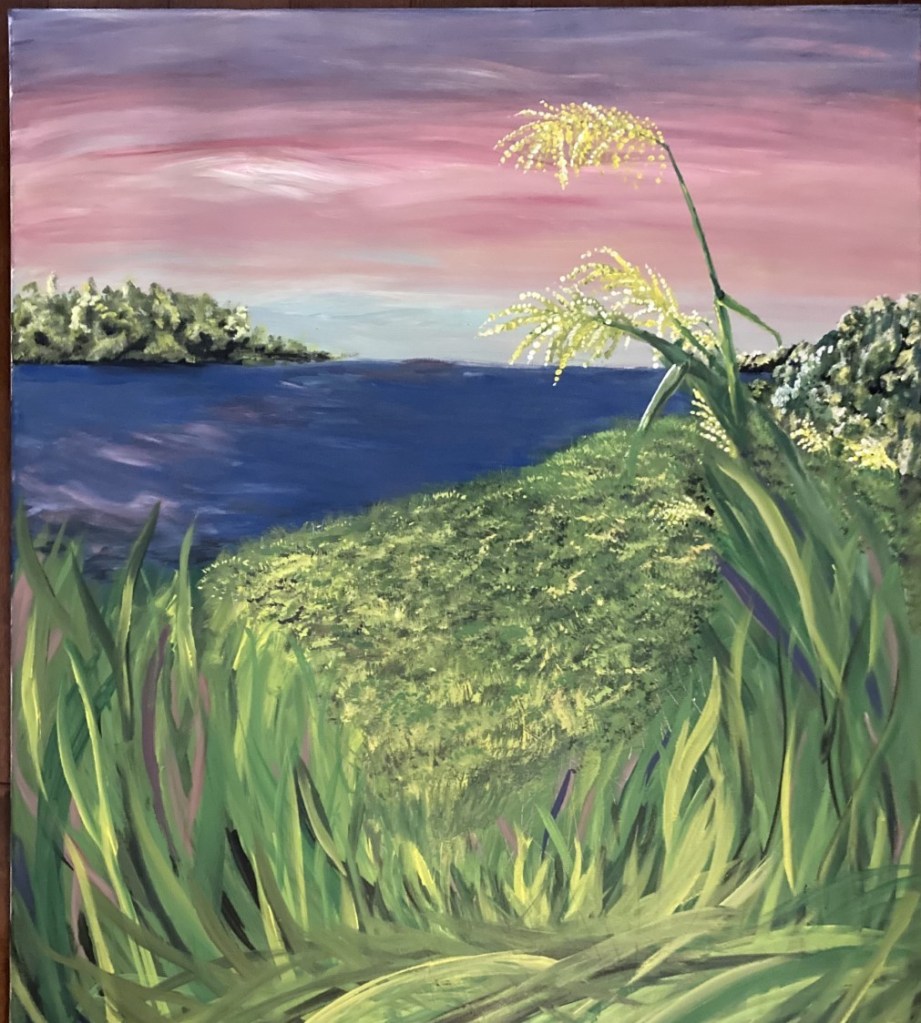
When I first planned to do this painting, I pictured some intricate multi-media piece that touched on all of the major threads from my learning. It would have the image of some journey, show art technique moving from paint by number to individual, incorporate some of the lacemaking or handweaving, and connect to knowledge and science through botany, grasslands, and beauty.
I had a lot of sketches for a concept, some I like a lot, but they just wouldn’t come together. I’d tweak them or make a new one as I finished a reading or did some reflecting, but nothing was working. Finally, I think in part because of reading Braiding Sweetgrass, I tried to take a broader and more grounded view of my learning in the last few months. I thought about what the point was really and what I wanted to share. I realised that my original concept was too convoluted for one painting, any one idea had merit but not together.
There was a lot of really valuable learning I did this semester but not everything needs to be shown in this one product. Through both the readings, assignments, and lecture content I’ve gained a better understanding of the value gained through learning beyond what you can report at the end. RW Kimmerer discusses trusting the learning of others and valuing their journey on top of what they can state on demand. So, in light of the pre-existing journaling, discussions, and presentations, I’m going to distil my main thought into a simple scene.
I decided to focus my piece on my own experience when I try to feel connection to my homeland, and how I interpret it as both a scientist and a local. I’ve lived in Saskatoon pretty well all my life but spent my summers at an old cabin by a small lake with my family. We knew most of the people there, and who are still there, but the park was large enough you could always find quiet. It was so far out of the way it didn’t even have radio and almost no one bothered to keep track of time. To occupy myself under the long summer sun I would read, listen to birds on our deck, or just wade in the water for hours.
That place is peace to me, I always feel safe. I knew the people, the trees, the weather, and could identify most happenings just by sound. Looking back, I’m so lucky to have gotten to know a place so intimately and feel so certain about where I was. What I learned from Kimmerer was that by being there I was also part of what made that place what it was. That quiet, unshakeable connection is still powerful in my life. I cannot go as often as I could as a child; little has changed there, little that mattered at least.
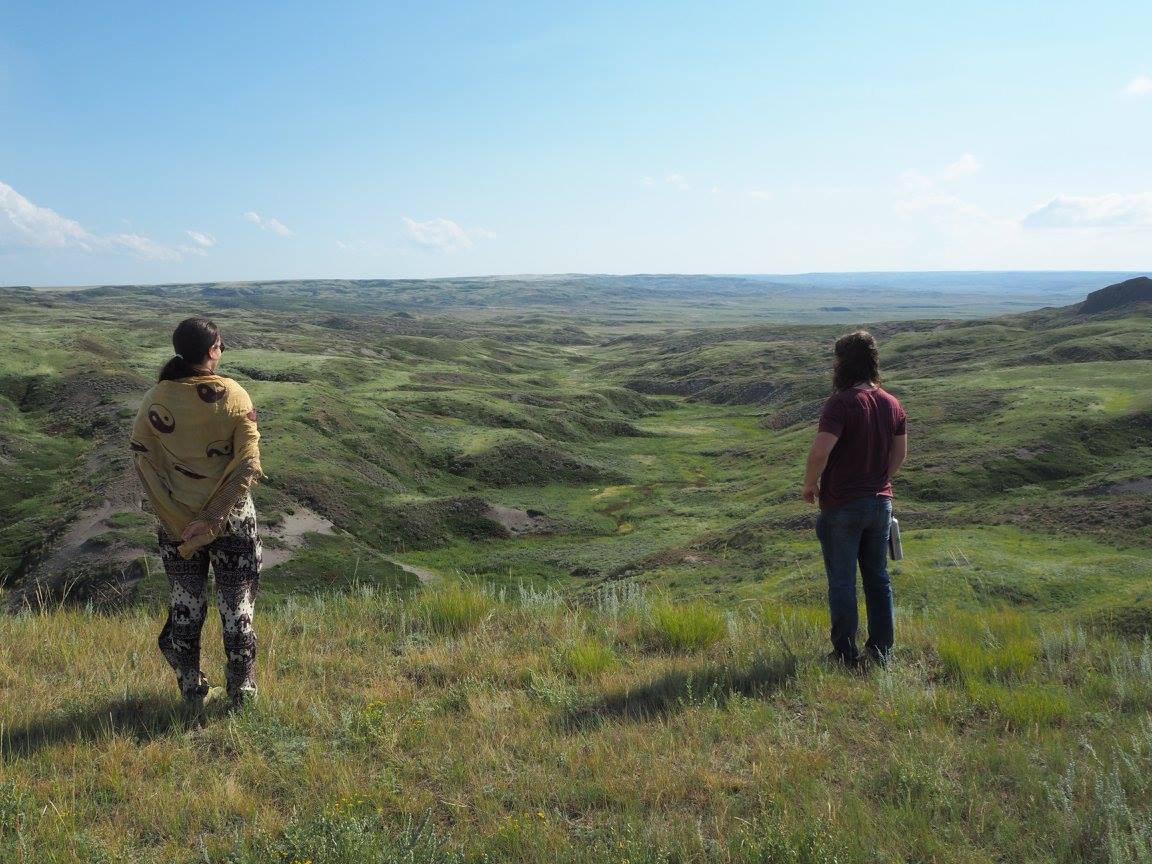
I painted the view from an empty hill, far but not isolated from people. The water is calm reflecting the gently pink dusk that lies opposite the blazing sunset. In the foreground is the colourful, long, uncultivated grasses which have been trodden on and bent. My intention was to place the viewer in the scene, showing were their body has been to sit and enjoy this view. Because humans are from the earth like everything else, and there is effect and interaction reciprocally between us and the earth. This can be loving and positive if we strive to make it so.
I’ve included the colours of some native grasses beyond green and I also did my best to stylise Calamagrostis canadensis, or Bluejoint Reed grass, which is an eye-catching native of Saskatchewan. I chose grass not only because it grows well, or better, with such disturbance but because of its importance to us here generally, and my own career personally. It’s the ‘bedrock’ of our economy now, the sustenance for the bison then, and the original coloniser following the glaciers which flattened Saskatchewan in the first place.
I’m lucky to have had the experiences I did, and privileged that my family was able to come here, stay there, and share all of our history with me. These threads shape who we are, our community, and our sense of self. These same threads in the first peoples of this land were deliberately torn apart through systemic government action and individual acts of oppression. However, those threads are not all broken or lost. There is so much to be gained by valuing the land, our relationships, and our journeys to support our students in weaving their own sense of connection and peace as they live their lives. I cannot handout these things, but I hope that by showing gratitude to that place and sharing my experience through art I can help some how.
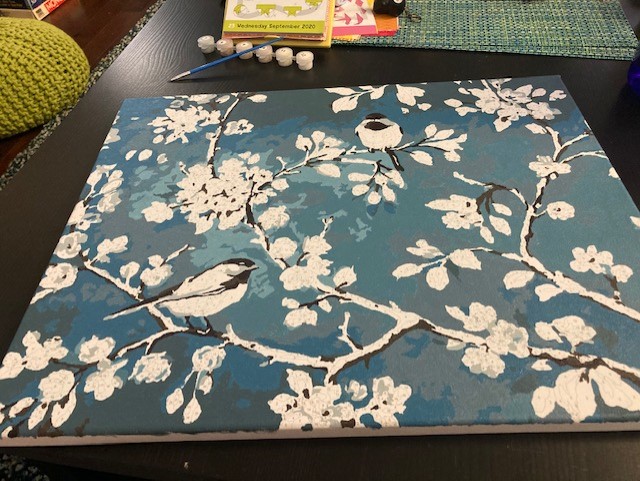
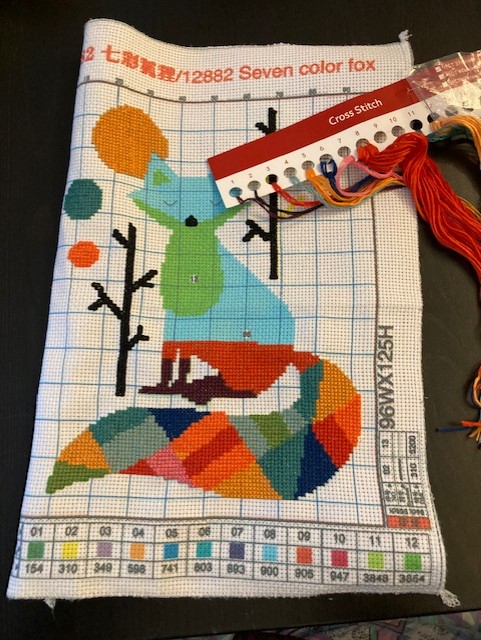
The art one, I chose to focus on discussing and presenting captions for them.
Doing the paint by number reiterated that doing art is a lot of work! Even without the design component the technical act of painting is involved. You have to have a strong sense of colour, the interplay of lights and form, and even just your physical hand. I really liked seeing how the look of the painting changed with every layer added.
Painting it also gave a lot of time to sit with myself, it was an active process but at times I got ‘in the zone’ and it really did feel meditative.
I chose to do a cross stitching project because its a craft in my own family’s history. My mother especially did lots of cross stitching passed on from her grandmother. As kids we spent a few summers cross stitching pokemon! Next time I enjoyed, it reminds of digital pixel art and mosaics in a way. Next time I think I have the confidence to do my own design though.
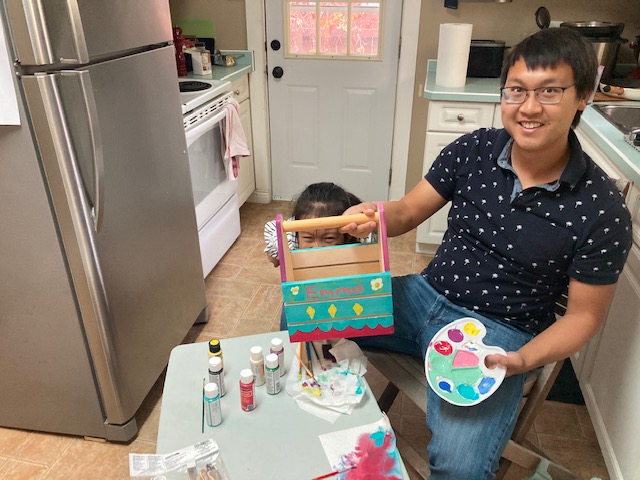
We had a ton of fun painting a basket with my niece, inspired by this process. She was happier with it this time because we drew our plan beforehand, learned from last time! She also was fascinated with even the paint water.
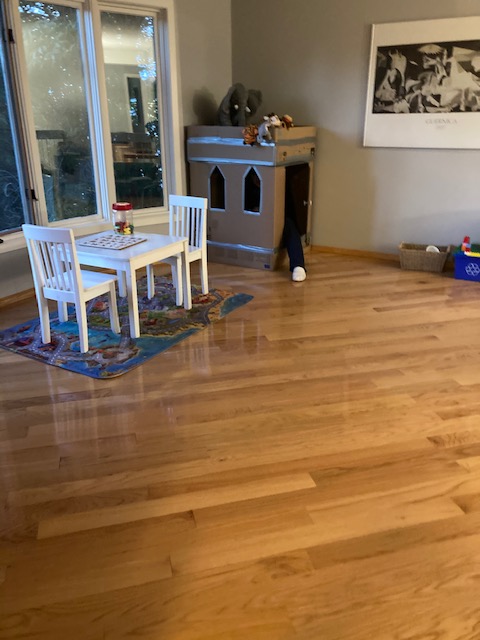
My brother designed and built this adorable castle for his daughter. She loves it, he loved it, and its repairable and memorable unlike an expensive store bought playhouse.
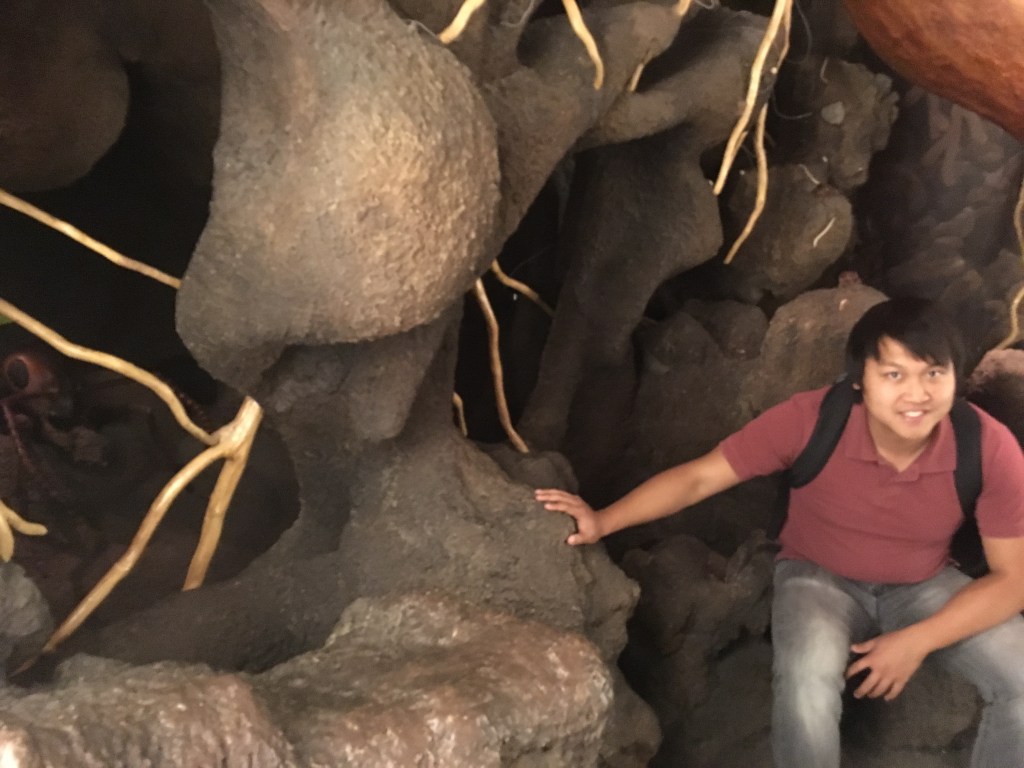
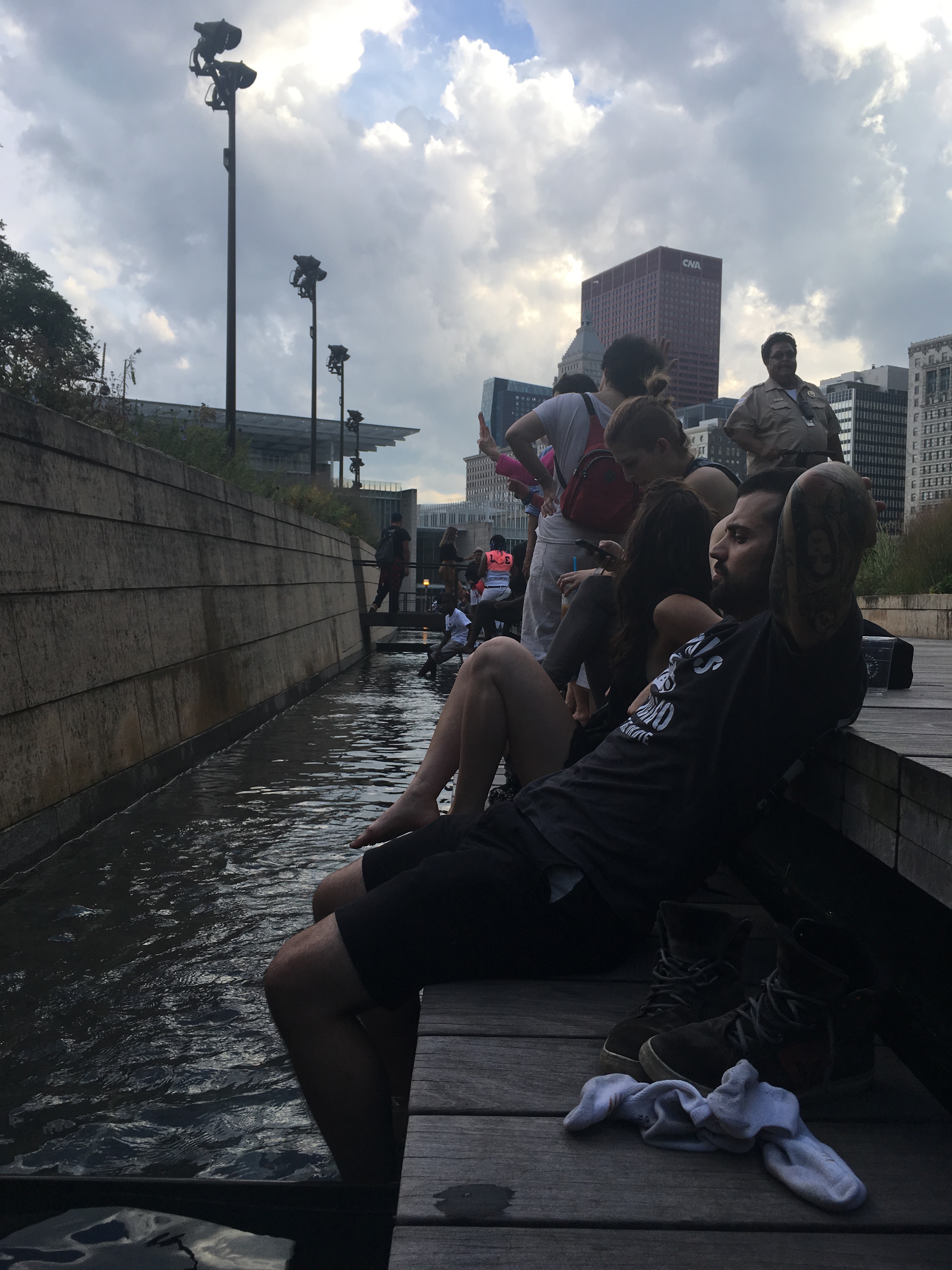
Science learning wise, I remembered an amazing exhibit I went to in Chicago (2018). They had a fully sculpted basement where you explored the ‘world of soil’ as an ant. Way more informative and fun.
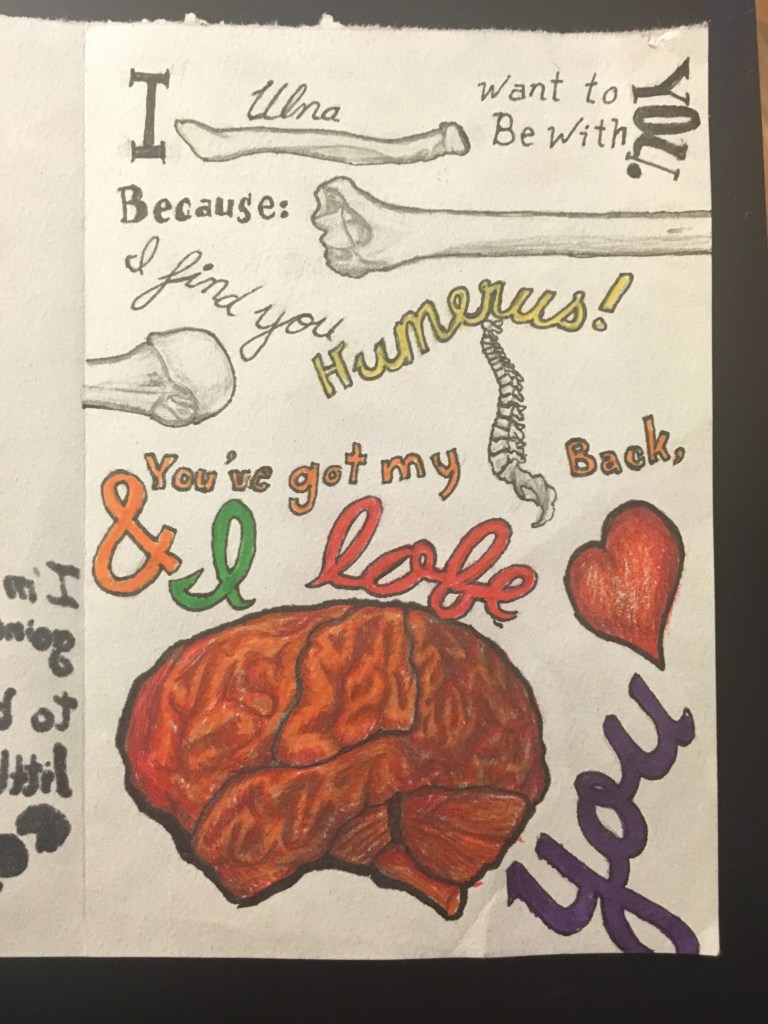
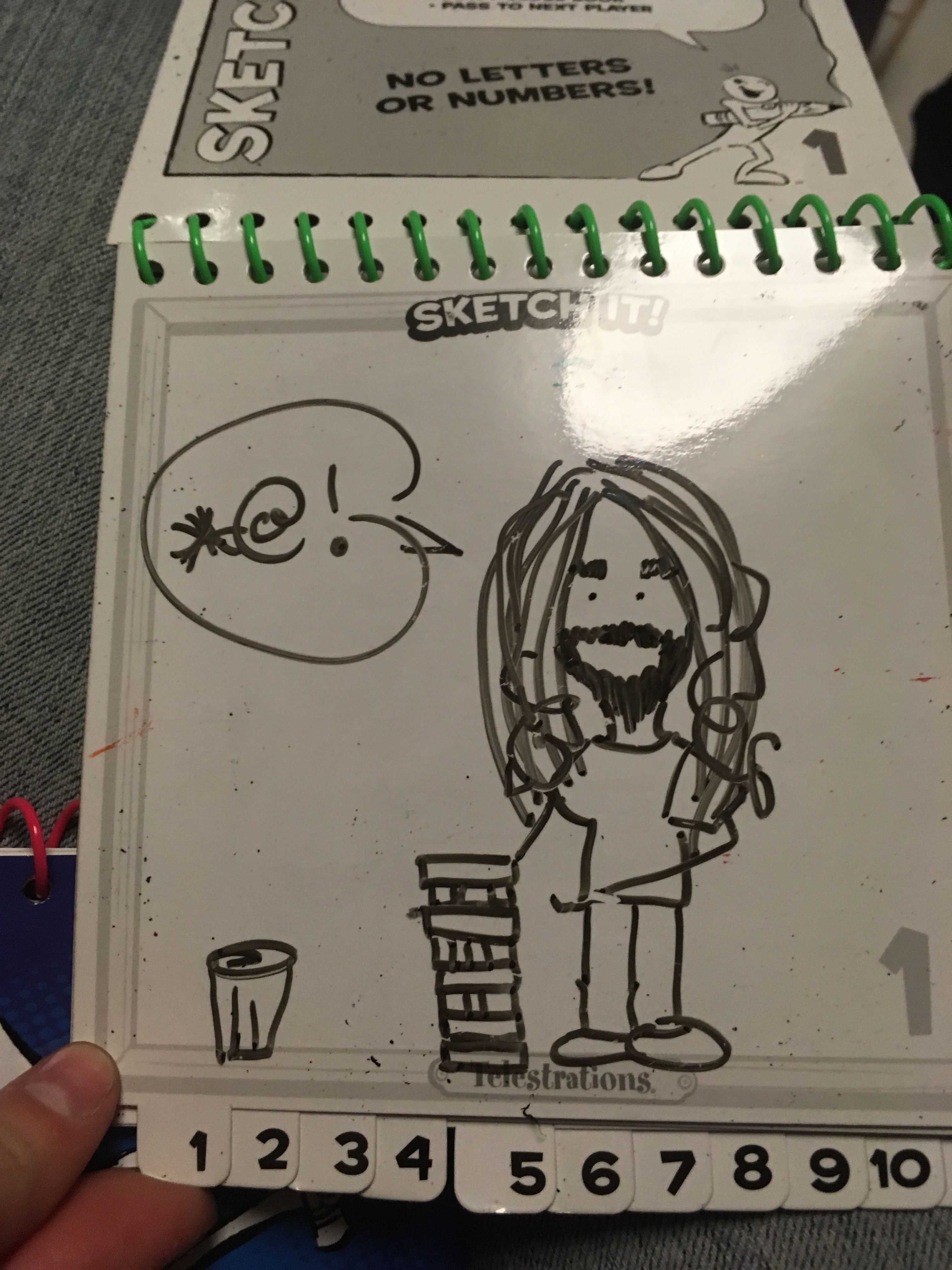
I also got to look back at some of the ‘cheesy silly’ things I’ve done in the past through a new lens. I’m actually pretty proud of this card, and my anatomical knowledge definitely helped support my weaker drawing skills.
I think making punny cards could be a good classroom activity!
I decided to try this a simply a Stream of Consciousness while reading Braiding Sweetgrass by RW Kimmerer. Rather than dwelling in the structure and meaning of my entry I’m going to instead focus simply on the stories shared and my responding to them as they come.
During my reading I felt a strong connection between both the 4Rs youth movement and Young’s Dis/Abilities paper. Both focus on developing critical literacy, though 4Rs is less explicit about this, and social activism in young people, though they have different focuses. Young focuses on dis/abilities and heterosexism whereas the 4Rs approach comes from the side of reconciliation. However, both appear to come to the conclusion that individual identity, safe environment, and meaningful communication are preqrequisites to meaningful social and crucial discourse.
Young focuses on developing the abilities of decoding language and message, connecting language and power, and critical analysis. The 4Rs focus on supporting introspection and self-evaluation in all students, guided and safe conversations, and “third thing”.
4Rs is an Indigenous and non-Indigenous youth give their perspectives, goals, and approach to reconciliation in Canada and social activism. Such a difficult topic and conversation, but the content of the site alone is an amazing window into the lives young people and how they relate to such serious topics. Beyond that they have a strong focus on platform, tools, leadership, and capacity building in young people that is both powerful and inspiring. Their focus on bridging the gap in reconciliation by developing strong individual identities and ‘connected/strong?’ diversity is a new approach to me.
I enjoyed the iterative and collaborative process that they have been following, especially is they were formed through the coalition of many existing your advocacy groups which formed the bedrock of their organisation. They have a clear and concise path towards there goal, by bringing everyone together on even-footing so that balanced and open discourses can take place amongst any young people.
They make a point of mention that many schools may not have visible diversity, and yet we must welcome and learn about diversity in every classroom. They’re discussion of privilege and diversity got me thinking about the fact that we all have our own unique positionalities. We have greater and lower levels of privilege in various spheres of our lives, even just by living in a democratic and wealthy country in Canada whatever our experience in this country might be. That said, we are also all lack privilege and have negative experiences as well. Especially in Saskatchewan there can be a disconnect from messages of anti-racism and critical discourse towards our colonially educated students. Through introspection and careful but difficult conversations we can support our students to bridge that disconnect as individuals and together.
This focus on looking inward and calm contemplation as a precursor to cross-cultural connection and critical analysis reminds me of a meditation initiative in California. The school started opening and closing everyday with 12 minutes of unguided meditation (after teaching the skill) in all classrooms. They found a great improvement in classroom management, attendance, and student achievement simply through giving students time to stop and breathe. Giving the space to simply be in their bodies as individuals and feel their own thoughts was apparently powerful in their school experiences.
I’ve been inconsistently dipping my own toes into meditation in the last few years and I definitely find it valuable. Again, it doesn’t always feel important or worthwhile when there’s so much going on, but I’m always happy when I do do it. Personally, I found that just listening the thoughts that arise without immediately assessing and addressing helped untangle my thoughts. Afterwards, I would feel both clearer mentally with a path ahead, but also physically calmer even when I hadn’t realised that stress had keyed me up.
I guess where I’m going with this is that I think many of us are disconnected from ourselves. We often don’t value ourselves as beings of body and spirit but rather solely for our contributions. In my experience, our society disregards the personal (identity, feelings, beliefs, hopes) in favour of the public (money, beauty, function, service). Its no surprise that when we don’t often consider our own selves as feeling, wishing, and hurting beings that its difficult to authentically do the same to others.
Going forward, I hope to try and integrate these strategies and values into my own practice for both my and my students’ development.
Datta is a really powerful writer, in an unassuming way. Much of his work is quite humble and the content is easy to comprehend. His paper on the community garden first interested me simply because of the environmental and local community connection it had but I soon found much more.
Firstly, his discussion of his own identity of an Indigenous Bengali man was eye-opening. Indigenous people all over the world face difficulties, but they also have great community and culture that we can learn from. Somehow hearing about his past opened my eyes beyond the story of the ‘annihilated and limping’ indigenous cultures living on life-support to look at the actual culture and people as a whole unto themselves.
Not to say that Canadian FNIM people are not struggling or that there are no impacts today, but rather that there are two stories happening here. One of the assault on FNIM communities and culture, and the second the story of those FNIM communities and cultures independent of outsiders’ interference.
His work also expanded my concept of ‘research’ by introducing me to the Participatory Action Research method which sets out to understand the supposedly ‘unquantifiable’. He sought to see sustainability through the lenses of the community gardeners. Datta did this by engaging and sharing in cultural stories, activities, music, and foods at the garden including sharing his own. I was impressed by how much he was able to learn about or ‘find out’ about sustainability and cross-cultural connection through this endeavor.
I personally surprised by how much more invested I felt in the paper just because it was local to me. In a way it relieved me of the burden of interpolating it to my experiences. I wasn’t stuck thinking ‘would that even work here?’, ‘that’s impossible because of our local environmental limitations’ and ‘Saskatchewan isn’t interested in these topics’ that I normally do with other social or environmental papers. But there really is wonderful things all around us at all times of year.
So often in both biology and education I’ve felt some options were not accessible to me because we don’t have enough people, we don’t have a warm enough climate, or some other thing but apparently that’s not true. This allow gave me the impetus to reassess some of my assumptions of my own life and home.
I think that following the strict definitions of ‘experts’, ‘knowledge’ and ‘truth’ that I’ve been brought up I limit both myself and my future students. Datta’s research does not fit into that model exactly, though it is still quite academically rigorous, and yet I learned so much from it. I’m excited to broaden my learning horizons to new people and to catch up on all that I’ve been missing.
From my own experiences, courses, and the readings I have a sense that the FNIM world-sphere has a greater appreciation for ‘non-traditional’ academic endeavors. I want to deepen my relationship ship with visual art both for my own piece of mind and for the sake of my future students. Knowledge itself is not attached to the written word as much as we may feel it is tied up in books. Students have all kinds of interests, experiences, and talents that they can use to interact with the world and express themselves.
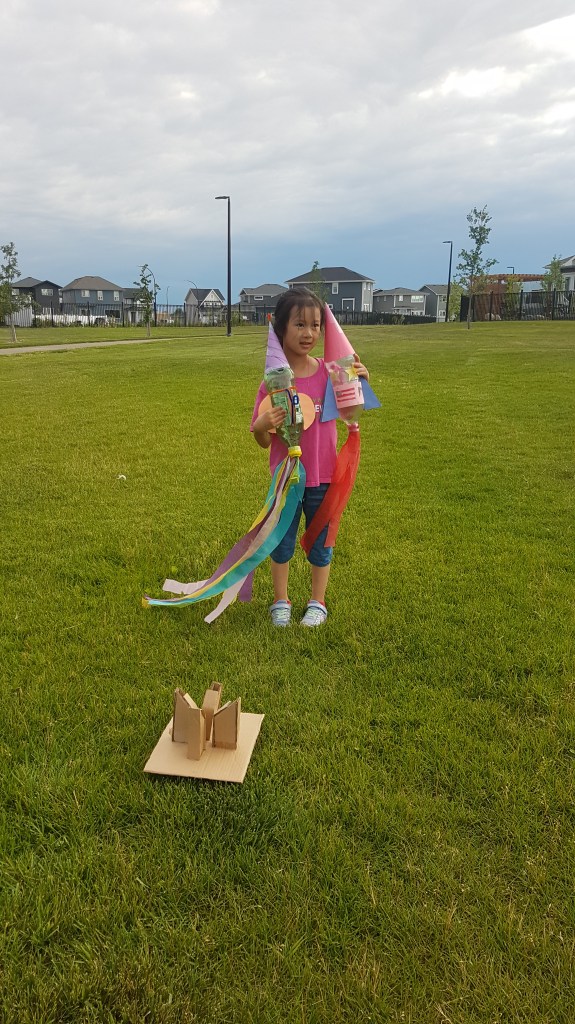
My niece with the bottle rocket we all made together.
We learned a lot about water pressure, when paper gets wet, picking up all of our garbage.
It was also fun watching the adults fuss over the little aerodynamic details of a hot glued bottle rocket.
She really enjoyed the decorating the most though!
Even in the working world I’ve found that little actually decision-making or problem-solving is done wholly through numeric analysis, even if only through additional oral discussion. There’s always interceding factors, relationships and more that influence, synergize/empower, and circumvent cold analysis. This is beneficial to businesses, employees, and the world because it is more flexible and responsive. Otherwise computers would be better at predicting climate, investments, and crime than they are now. Beyond that though, work isn’t/shouldn’t be the most important thing in anyone’s life, and personal lives rarely rely on cold hard facts if ever. Even financial decisions require judging the validity of information and predicting the future stability of non-monetary factors.
All this is to say, that while cold hard facts can be powerful, they are useless on their own and often not actually applicable at all when it really matters. I think it is important to be informed but as this year has shown us, we are still led by our heart more than information we’ve gotten from the ‘information age’.
I feel like my own culture, colonial European culture, has left behind lots of its traditional and aesthetic pursuits while running in the global rat race. For this reason, I’m hoping to learn more from other cultures, especially Canadian Indigenous cultures, about the role are can play in our lives and in our learning.
Through reading selection options, I developed my own personal goals. I think it consolidated many thoughts and concerns that I’d been having through my education school career but hadn’t had the time to explore in depth. I surprised myself with how clear and motivating I found my guiding principles. A broader appreciation of knowledge and expression supports connection.
I also clearly felt my own discomfort in these spaces, like I’d walked in on someone else’s family dinner. I felt that there was something wonderful and special there but at the same time I felt both and urge and push to leave? This isn’t something I fully understand myself, but its strength makes me thinks its something important to explore deeper. Personally, I don’t want to be beholden by an impulse that I don’t understand, trust, or know the source of, especially since it doesn’t seem to be serving any helpful purpose.
I think I have a blind spot and bias against the ‘unquantifiable’, that if it cannot be measured that it cannot be relied on and is therefore useless. I know conceptually that none of that is true or even accurate, many complicated and human things can be measured and many ‘facts’ are not measured honestly, this is simply a bias I’ve allowed to go unchecked.
In part I think this is defensive, this isn’t a part of myself that I’ve ever explored despite my personal interest because I didn’t feel it was acceptable or valuable to do so. I resented past experiences where, as a student especially, the message was to be creative but the reality was that your options were to slap paint on a pig (colour strict academic product), create a masterpiece taking many hours beyond the scope of the activity which ‘earned’ its right to be assessed as learning, or try and fail receiving comments that this creative endeavor doesn’t actually do what an essay would have done and therefore is useless.
To be frank, looking back, I’m not sure how many of these messages were even explicit or intentional. Maybe my own insecurity in my abilities read to far into the comments I received. Maybe my message was confused regardless of the creative liberties taken. But I sure that no major assessments or learning were done without concrete work shown on loose-leaf.
Education is one of the few unifying and common experiences in our society, as a teacher there is a great responsibility to give as many students the best experience as possible with learning, institutions and adults in general. Schools are not neutral places, but they should be both open and reliable to our students as they are discovering themselves. The relationship is easily soured, even accidentally, and hard to repair in the short semester we have with them.
There is bad blood, especially in science, which has a negative reputation despite the popularity of pop science and technology in our culture. II hope to empower students to be independent learners and their own informed advocates, because knowledge really is power and it belongs to everyone. I think that there has historically been a disconnect between what students need and how curriculum is delivered, but this doesn’t have to be so. Content comes from the world around us and isn’t more valuable if we make it unapproachable.
A major focus of my teaching philosophy is that it is my duty to set students up for success with quality assessment and preemptive classroom management. Create units, lessons, and assessments which make the best use of my students time and attention by being pointed and applicable. I hope that this will enable faster feedback and effective instruction so that students will be able to accomplish our learning goals. Secondary students are still young, exhaustive homework and stress create a negative association with school and learning in general which I do not think is exactly necessary in our classrooms. Instead, I will try to develop them as active and interested learners with a grounded understanding of the content they feel they can confidently use in their lives, that it’s worthwhile.
From a classroom management perspective, secondary classes are only mine for an hour a day so I have to make the best of the time we have. By focusing on clear daily expectations, and a somewhat regular routine students can focus on other things. Optimizing classroom layout for the activities you have by arranging desks and materials in accessible ways is important, along with having clear ‘flags’ or actions which signify the beginning and ending of instruction, as well as others for the lesson as a whole will bring consistency to your classroom. By also planning flexible time for group discussion and unexpected questions reduces stress on me as a teacher and won’t require as strict of classroom management. It is also important to be clear in what you and do not expect behaviour-wise; when is it okay to talk etc. so that everyone is on the same page.
All of this is getting at proper preparation which then allows for flexibility in other aspects such as format and students grouping and hopefully will allow for more complicated activities without wasting time managing students. It is also important to realise that they are young adults, as a teacher I can let them know how they are progressing but beyond directing them and the class I cannot drag them to do learn the do not wish to. I can assist them with as much as energy as I can but not much more than they are willing to put in themselves or it will detrimental to me, other students, and them.
These cases were written by Diane Clark for EPSE 348. I’ve included the assignment as well as my own responses to the assignment as it was a very interesting exercise, and I was happy with my efforts as well.
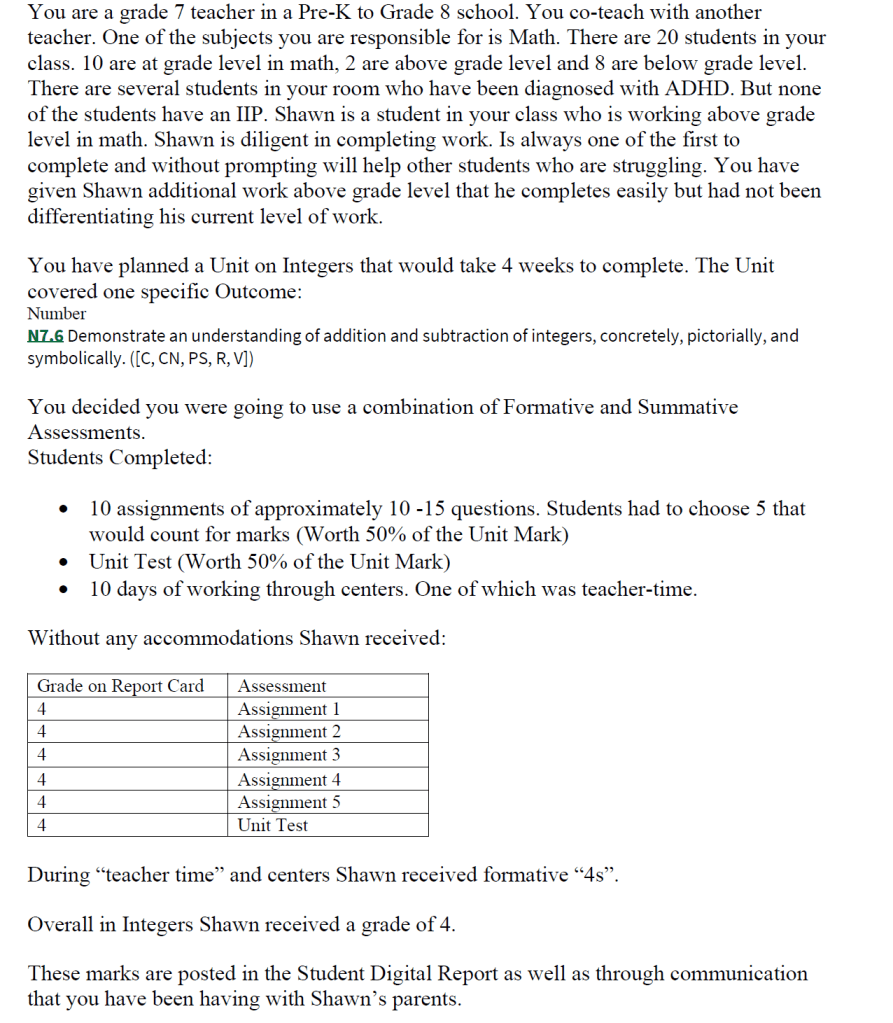
First Case
Analysis1
1) Create 2 Learning Targets from the above outcome.
A) Students use integers drawn from a deck of cards to move their piece along a track, they may only move if they select the correct square (e.g. correctly move +3 or move an opponent -2).
B) Complete a worksheet of integer addition/subtraction with an emphasis on opposite integers (notice pattern of opposite integers equal 0).
2) Provide and explain 2 unique examples (not from the Case Study) of Formative Assessments based on the above information for the Unit on Integers.
A) Have students step forward and backwards tiles starting from a line on the floor in accordance with addition of positive and negative integers. First as partners stepping and calling and (then blind folded?), succeeding if they are on the correct tile at the end of the instructions.
Purpose: Develop understanding of positive/negative integers and practice their use symbolically. Measurement: Have they correctly added the integers and counted the tiles to the right spot. Evaluation: Accuracy, confidence in steps, speed of steps. Use: Formative, practice, and diagnosis. Good for motivating student interest, visualising content, practice thinking of numbers as integers with positive or negative directionality.
B) Have students guess why we use the phrase “two steps forward, one step back”. Purpose: recognise integers and use their own knowledge of integers to interpret the phrase. Measurement: At least one full sentence and a reference to integers. Evaluation: Show understanding that +2 + -1 = +1, logical consistency. Use: Formative, create interest.
3) Explain how the “teacher-time” during Centres are a form of AFL.
It allows for checking of student learning one on one so that teachers can evaluate their level of understanding and mastery of knowledge to inform future assignments and lessons. Students are able to discuss their difficulties or further interests on the unit as well as update the teacher on how they’re personally feeling about the unit so far. As a teacher they are then able to prepare better assignments and lessons depending on student needs.
4) Provide and explain 2 unique examples (Case Study) of Summative Assessments based on the above information for the Unit on Integers.
A) Solve word problems (with diagrams) such as conclude how far someone has travelled along a road after going back forth various metres. Purpose: Use integers, interpret ‘forward’ and ‘back’ as positive and negative integers. Measurement: Underline integers, show work, circle final answer. Evaluation: Method of solving, correctly values, accuracy. Use: Summative, diagnostic.
B) Assign students a sheet where they have to ‘balance a cheque book’ with both simple whole number incomes and costs for a household. If they finish early, they can attempt to improve the budget by altering the various costs. Purpose: Use integers in a concrete situation, interpret money as numbers. Measurement: Correct monthly budget sum. Evaluation: Accuracy, correct method used. Use: Summative
5) Is Shawn motivated by Performance or Mastery learning?
Mastery, Shawn is interested in work beyond required for the grade and engages with the content after he has completed by assisting fellow students.
6) What accommodations or adaptations would you have made specific to Shawn (at least 3)?
A) I would give optional activities/challenges to assignments so he can continue to learn.
B) I would focus on giving other forms of detailed feedback beyond grades such as written and in class comments, so he is still understanding his progress.
C) I would give these as ‘bonus marks’ so that he can be challenged and get them wrong without having his grades suffer since he has achieved the outcomes.
7) Would Shawn’s mark be different from the above Report Card? If yes, HOW? If no, Why not?
No, he has consistently achieved 4s throughout the unit. He shown clear understanding and accomplishment of the outcome throughout assessment. Shawn’s marks may not be as informative and meaningful to his learning as they might be to other students, but he has earned them.
7a) What final mark(s) would you give Shawn in this Unit and why?
I would give him 4, mathematically and scholastically this is the mark he has achieved. It is an accurate reflection of him meeting the curriculum outcome and therefore there is no reason to change it, there is not mark higher than four.
8) Are you using norm referenced or criterion grading?
Criterion grading, there is no value in trying to compare students, especially in this case it may drive down others grade unnecessarily.
9) Discuss how the 4 Components of Classroom Assessment were/were not attained.
I think that there is evidence of all four components of classroom assessment in this class.
Purpose: It is hard to know but it appears that the assessments must be purposeful as their a variety of them which shows care, students being able to choose only 5 out 15 assignments is best served if all of the assignments are relevant to all of the outcomes. This unit only has one outcome so we can assume that that is true but there are four different formats in that outcome which should be considered. Measurement: Learning was measured through assignments, a test, and ten centres that we don’t get a lot of details about but seem to be diverse. There may have also been questioning during the lessons and other forms of informal measurement as their comments on student activity such helping others. Evaluation: Presumably, evaluation is focused on correctness of assignments, although marks can also be based on methods used and speed (though that is not best practice). Use: Besides the centres they were all summative assessments, though the assignments should have also informed the teacher as the unit progressed depending on their completion date.
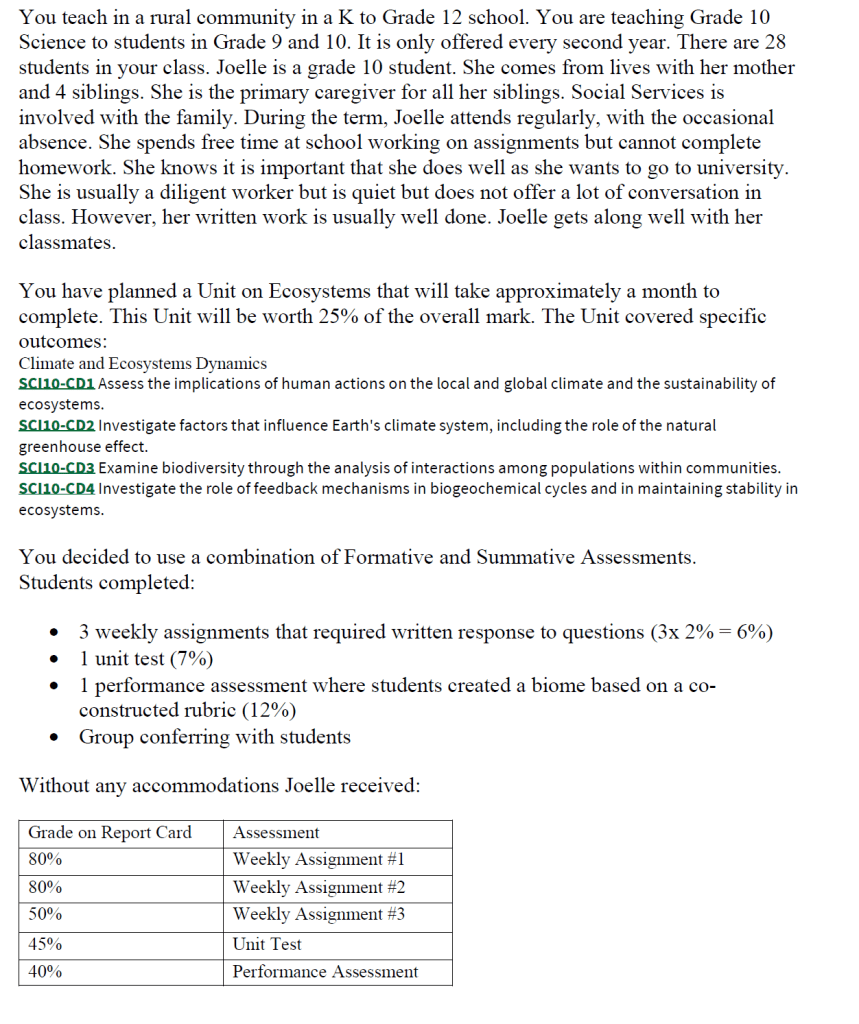
Second Case
Analysis 2
1) Create 2 Learning Targets from the above outcome.
A) SCI10-CD4 Label a diagram of the biogeochemical cycles and their feedbacks from a word bank
B) SCI10-CD1 Discuss the impact of the school and it’s activity on the local ecosystem (including it’s construction) .
2) Provide and explain 2 unique examples (not from the Case Study) of Formative Assessments based on the above information for the Unit.
A) SCI10-CD3 – In groups explore and discuss the patterns of biodiversity they can find on the school grounds including weeds. Draw/describe two biodiverse organisms (plants etc.) and state a pattern to their lifecycle (e.g. grow in sidewalks and dry places). Purpose: Examine biodiversity in person and work to discover patterns in communities. Measurement: Engagement with activity, distinct characteristics of organism, reasonable assessment of community pattern. Evaluation: Completion, two distinct details per organism, a personal observation and evaluation of organism to find pattern. Use: Formative, diagnostic and body break.
B) SCI10-CD1 Find a news report on a local or provincial environmental issue and discuss in groups what and why that is happening. Purpose: Discover the implications of human activity on local ecosystems. Measurement: Article relevancy, understanding of issues discussed. Evaluation: Article selection shows understanding of issue and what is relevant to the discussion, participation Use: Formative, student analysis and check-in on their comprehension.
3) Explain how “daily group conferring” is a form of AFL.
It allows for the gathering of evidence of student learning through their discussion, teachers can evaluate their level of understanding and mastery of knowledge to inform future assignments and lessons. By occurring daily students become more comfortable with the activity and the teacher has a very up to date understanding of what lessons have been successful and where each student needs to go.
4) Provide and explain 2 unique examples (not from the Case Study) of Summative Assessments based on the above information for the Unit.
A) SCI10-CD4 – Create a picture/narrative/diagram/essay which illustrates one completion of a biogeochemical cycle and its feedbacks as completed in class, excluding the water cycle (water cycle example given). Write at least 75 words in some way on why this is important to ecosystem stability. Purpose: Fully examine a biogeochemical cycle and its role in the larger ecosystem Measurement: Meets all requirements, complete cycle is presented as logical series of consequences and major impacting factors are included. Clear illustration of how the cycle creates stability. Written component is accurate, concise and uses correct terminology where applicable. Evaluation: Rubric of the above qualities emphasising inclusion of factors and their relationships. Use: Summative, assignment will be a major component of unit mark.
B) SCI10-CD2 – Students will conduct an experiment that illustrates the green house effect by using heat lamps on two bottles of water, one of which includes baking soda which will release CO2 and heat faster. They will fill out a simple lab report inclu ding methods, a temperature data table, and a concluding paragraph. Purpose: To understand the impact of greenhouse gases and connect physical and chemical phenomenon to each other in person. Measurement: Completion of lab report sheet as described above Evaluation: Lab report conclusion includes discussion of ‘green house gas’ and the importance of the baking soda to this experiment, as well as overall completion and accuracy. Use: Summative, hands on experience, lab safety, connection from lecture to life.
5) Is Joelle motivated by Performance or Mastery learning?
It is not as clear because she seems to be motivated by university acceptance, but her continued work despite recent poor grades would indicate a mastery motivation.
6) What accommodations or adaptations would you have made specific to Joelle (at least 3)?
A) I would have discussed her performance after the first low mark (assignment #3) to see what kind of difficulty she is having with assignment (time, space, focus etc.) and worked with her to find solutions to that for the future assessments.
B) I would have offered extension of the due date if she needs more time to work on them in school, since it seems she is unable to do so at home.
C) I would consider altering the weight of the components to reflect the differences in difficulty of her situation through the month, assuming outcomes were covered throughout the assessments or marking components of the larger assignments in chunks.
7) Would Joelle’s mark be different from the above? If yes, HOW? If no, Why not?
Yes, hopefully through accommodation her marks on the later assignments would be improved to at least 3s. Her earlier work shows that she can complete the work to a higher standard and there is no reason to think that accommodation and teacher support would not allow her to reach that standard for the other assignments. Retroactively deeper evaluation can hopefully focus on where she demonstrated her learning of the outcomes and maybe reduce superficial/irrelevant places that marks were placed. Depending on the evaluation done these changes may need to be made to the rest of the class (except the co-created rubric).
7a) What final mark would you give Joelle on the Unit and why?
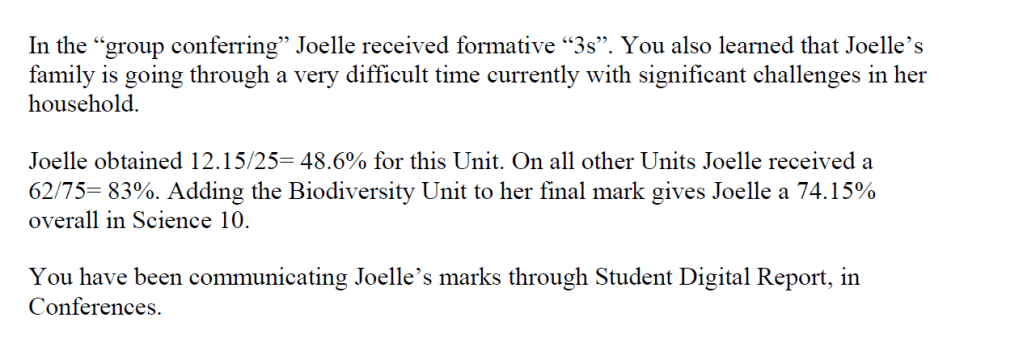
Depending on the outcomes the assignments cover I may consider dropping portions of the unit test / performance assessment which she had earlier shown understanding of, this may increase her mark. I would also adjust the weights of the assignments to include marks for the group conferring , although it had been intended as formative assessment and she is quiet she may have been better able to demonstrate her understanding in that format as opposed to the other assessment considering her personal situation. My changes would bring her mark up to 13.95/25 = 55.8% which would bring her final mark up to 75.95%, I’ve shown the changes in the table below.
Without any accommodations Joelle received: Grade on Report Card
Assessment
Original Weight
My Adjusted Weight
80%
Weekly Assignment #1
2%
2.5%
80%
Weekly Assignment #2
2%
2.5%
50%
Weekly Assignment #3
2%
1%
45%
Unit Test
7%
5%
40%
Performance Assessment
12%
10%
75%
Group Conferring
0%
4%
Final Unit Grade
–
12.15
13.95
7b) What final mark would you give Joelle overall for Science 10 and why?
As discussed above I would give her a final mark of 75.95%. The unit cannot be dropped from her mark because we must assess her mastery of the four outcomes of the unit but the original assessment may not accurately reflect her mastery either when compared to her learning in class. Overall this is not a large change but hopefully it will motivate her to continue her efforts in class and make her feel her situation is being seen so she can bring up future issues as they arise.
8) Are you using norm referenced or criterion grading?
Criterion, there is little value in comparing students to each other rather than the curriculum outcomes and how they have achieved them.
9) Choose 3 steps of High-Quality Assessment and discuss how you might use them during this Unit.
A) Practicality and Efficiency: I would place a greater emphasis on assignments that can be completed in class. Check if there are unnecessary requirements and ‘bulk’ such as in-depth writing or irrelevant questions which focus on effort rather than the outcome. More efficient assignments best utilise students’ time and motivation.
B) Positive Consequences: Bring energy and interest into the classroom through engaging and fun positive consequences made available to students through a variety of ways.
C) Clear and Appropriate Learning Expectations: Be sure that the learning expectations are very clear and explicit so that students can prepare themselves for the semester ahead and best focus their efforts to relevant work. This will all provide guidance and a path/workflow to students who may have less focus or ‘bandwidth’ for the practicalities so they can focus on learning.
So far, I’m finding my experience in the college positive. It was a major adjustment coming from work in a microbiology lab and my previous degree to education. The courses are more informal and high concept and I felt a little unmoored without specific facts and systems to learn, but I think that that has been good for me as a person and as a learner. I’ve had to increase my confidence in stating my opinion, the ultimate science taboo, and discuss qualitative concepts in much more depth then I ever have before.
It’s very interesting to see the differences in courses, professors, and teacher candidates because everyone has their own take. I’ve had some frustrations with courses being a little wishy-washy, repeating similar concepts with single cumulative, loosely defined assessments. But there was still value in the differing perspectives and experiences that they brought to the table. You can still learn more about a concept if you look through a different lens with different people. I do feel a significant improvement in my understanding of the language and conventions of education as a profession and I hope that as I’ve completed these introductory courses I will have deeper understanding in the future readings and the like, now that I know exactly what they’re talking about.
I’m still very happy to pursue teaching as a career. I think that’s the advantage of coming into it after having experiences in schools and working in another career beforehand. I’ve gotten very positive feedback on my planning and flexibility so I hope those skills will support me while I catch up on my deep understanding. I’m so happy to use the new concepts and philosophies that I’m being exposed to and think back to my previous experiences with students. I can see what they teachers were doing with their classes, why some of my planned activities did not work, and hopefully how to better certain classroom management problems more effectively.
I appreciate having more professional direction through curriculum, differentiated instruction, and effective assessment. Now when I think to what my own classroom might look like and my own lessons I have a much better picture and framework than I did before. This gives me even greater confidence and excitement towards my future as a teacher.
What does “teacher identity” mean to you? What does your identity look like at this phase in your career as a teacher?
My understanding of teacher identity changed in response to this course and the professionalism conversation that continued through the course and as I learn more about the history of teaching broadly and locally. At this point my identity is still very vague, I have a passion to bridge the gap between interest and understanding in science for my students but and just starting to learn of all the difficulties and frameworks that must be accommodated in order to bring good teaching to my future students.
How did the type of school I was in shape my high school experience?
My high school gave me a greater sense of trust in schools and belonging than I think most students experience. I went to Murray, a large and technical collegiate in the city which defined my expectations of high school. I was in what is now called SAGE which gave a consistent cohort of classmates for my main subjects but had a huge amount of options for my elective courses which were all well resourced. I think this allowed me to form a lot of connections to different people and find belonging despite being a weird kid (like all kids) without having to change myself.
I feel that this experience is one that not all people have, especially in smaller communities where options are limited, and the social sphere is much narrower. I must remind myself that bad experiences were not rare for everyone and that stereotypical terrible high school are not only in movies.
The two major components of differentiated instruction for teachers to consider are the learning and cultural dimensions.
To facilitate differentiated instruction for learners we can work to create lessons and assessments that are clear, explicitly described, and focused on specific curriculum components. By doing so we then have clear understanding of what we can cannot alter to best suit the learning needs of our students and also better see which parts of our lessons are causing difficulties. Students’ learning needs are so diverse that it can be overwhelming and easy to focus on what ‘good’ and ‘bad’ school work looks like rather than what are we actually teaching and testing.
Does the writing need to be in essay style or can students be more concise? Are we marking their preforming ability or their content understanding? Is this assignment larger and more involved that it needs to be to address the outcome I desire? As teacher’s these are all things that we need to consider.
To differentiate our instruction culturally, we must think critically think about all of the resources and language we are using and not just repeat lessons as we received them. We can reach out to different groups in our community to become involved in our classroom. As teachers we must model and encourage listening and understanding in our classrooms in all situations, and then we must expose our students to diverse cultures and perspectives. This is all an effort to create a welcoming and inclusive classroom environment for all of our individuals students without othering or emphasizing one point of view.
For each of Assessment For, Of, and As Learning, briefly describe the assessment mode in your own words and provide an example of how you have encountered this in your own learning. (3 paragraphs, 3-5 sentences each)
Assessment Of Learning: What we first think when hear assessment, these are the summative assessment the lead to grades and should represent our overall mastery of the content. These assessments most need explicit descriptions and criteria because they are used to evaluate student progress and achievement. Therefore they are ‘higher stakes’ because parents and administration primarily evaluate student learning from this information. In my own learning I see this in the rubrics and grades that come out after assignments in my courses, and depending on that feedback I can better understand my mark and achievement as a learner.
Assessment For Learning: This is the next most common form of teacher assessment, a check-in on how students are doing. This is formative assessment which is done both formally and informally to help you as a teacher form an understanding of your students learning. Are they having difficulty with a particular assignment? Did they all get a certain question wrong in the same way? Those issues can only be addressed if you see them. As a teacher you must assess your students and yourself so that you can quickly change you teaching to better suit their learning when there are gaps or misunderstandings happening. In my own learning I’ve seen this in the group discussions that happen in class, because although there is a lot of learning happening they’re never graded but our professors will rest or pass items depending on our understanding and interest in the topics which improves the courses.
Assessment As Learning: This is harder to understand and use effectively, but it is ultimately self-reflection and learning about our learning done by students themselves. It can give greater insight into their own strengths and weaknesses and identify their own patterns. Delivered by themselves or their peers, it can elucidate patterns of success and common pitfalls which students can then address and improve for their own benefit. It creates a greater sense of self-control over their own learning. I haven’t experienced this as often as the other forms of assessment but the first that comes to mind is the quizzes we did in this class. It got us to assess our own learning styles and teaching values and then reflect on how we see that in reality which gave me a new perspective on some of my own behaviours.
I would use assessment for learning throughout lessons because both me and my students need to be on the same page. This can be as simple as questioning the class at large or asking individuals how the lesson is going. Assessment of learning is the most pervasive in the classroom but also the most wasted. Often assessments are confused on their purpose and don’t align well with what the real expectations are so I would work to create summative assessments of learning which avoid that. Finally assessment as learning I think is most useful either in small chunks regularly such as exit slips about lesson feedback, or peer-teaching/feedback done slightly before the end of a unit so that students have a chance to better prepare for the ultimate assessment of their learning whatever form that takes and gives them the best chance to succeed.
The documents have overall similar content but are different. Most obviously the Manitoba document is 430 pages or ten times longer than the Saskatchewan one which probably reflects slightly different purposes in their writing.
Manitoba has a section describing how science used to be taught and how they now want it to be taught, which is more explicit than our literacy definitions and scientific thought goals but may also cause teachers to be more defensive.
They have a similar emphasis on science as related to technology as a foundation of understanding. They do not have explicit BALs and CCCs like we do. Instead they have learning goals related to science such as Nature, Science and the Environment, and Attitudes which includes safety and the like. Their units are divided into outcomes the same as ours though and give much more detail about what is in each unit compared to our curriculum.
They do not have exemplar indicators like our documents but they do have more examples of lessons and activities. They also have a very in depth resource on engaging students, properly planning activities, instructional methods, the learning process, and unit development which are documents seem to lack.
I think that I prefer the clear and concise formatting of the Saskatchewan curriculum but that Manitoba is superior for teachers who are unfamiliar with teaching and biology. I think that our curriculum could have much more resources on the specific units within in a course but for quick reference, planning, and specific course goals I prefer the Saskatchewan document.
It was interesting doing these quizzes in class. My personal VARK was very biased towards physical and auditory learning with a zero in reading/writing which sounds true to my life. My MBTI profile was INFP, I kind of am a very intuitive and feeling person which is kind of interesting coming from a science background, I have feeling some of my friends may see me as more of a sensing person than an intuitive one based on my love of trivial facts, but agree that despite my understanding of a situation I always go by feeling.
Learning is complicated, but I see these profiles in my learning. I really thrive in discussions and questioning but cannot process verbal facts and figures for the life of me, but both are auditory. I always take notes covered in diagrams and arrows because otherwise I don’t fully process the information that I’m writing down so I fully accept my weakness in that area and hopefully can practice to improve it somehow.
I think my learning style would be helpful towards my students in that having a lower reliance on reading/writing it should be easier to adapt when there are ESL students or others where written instruction is not always easy, I also hope that by seeing the world through Intuition and perceiving I can bring more joy and curiosity to what could otherwise be fairly dry lessons. I hope this allows to create greater connections between my students and the content increasing their engagement. I do worry that I may end up giving confusing or incomplete written instructions or feedback which will be bad for students who rely on that information either from their own learning style or for practical reasons like accessibility or future reference.
The TPI gave me an average of 34 which I think shows I have some lofty goals for my teaching, and also that I’m consistent between belief, intent, and actions. This is easier for me to say now because I’ve only spent six weeks in a classroom, I’m sure as I continue my practice that things will change and focus. The exception being that I intend to, but do not act or believe in developing students knowledge from their point of view which is new to me. I am not surprised that I value apprenticeship learning and transmission of knowledge because that is my own preference for learning that I see as valuable. I think developmentally I had the perspective that wherever students are coming from they can gain some learning from any content if presented in the right way but that is something I will have to keep an eye on.
High school is a scary and exhilarating new step! I know you’re stressed so I’m just going to say remember that high school is still just a school same as elementary was, you’re smart enough to make it through! Although teachers and everyone take things seriously, this is the time that you’re allowed to be a confused and terrible person with less consequences. Take some risks even if things might not work out, both socially and in academics. Like everyone says, class is easier if you the homework a bit earlier, but I still haven’t mastered that skill so no tips from me. If homework is really challenging you talk to your teachers about it, its not an inherent flaw in yourself or difficult design on purpose so they can give you more insight than stressing a lone can do.
High school is only four years, but it is almost as defining and special as people say. Lot of new people and freedoms and growth while all your friends are constantly with you all day. That said you can’t really ruin or waste your high school experience being honest so don’t be too afraid to try new things or making mistakes. Even the confident people are full of hot air in high school, despite how certain they sound so don’t be afraid to speak up or question them.
When you get down to it, trust your own judgement more than your peers and listen to your own thoughts. Really just try new things sometimes, talk to people and you’ll be fine. I’m satisfied with the amount of daring, dumb things I did but wish I’d been more out there day to day with people. Looking back, I never let myself be in unsafe situations so being cautious was a not worth being embarrassed about because many people did end up making serious mistakes. My advice is just to keep an open mind but know that others don’t know as much as they think so don’t let them scare you. Also, don’t talk so much in class.
INSTRUCTIONAL METHODS FOR SUPPORTING SECONDARY INSTRUCTION
Inquiry: Teacher facilitated but student led investigation. The topic to be investigated is decided by the student(s) and teacher guides them to curriculum connections and skills while allowing the students to lead their own learning.
The strength of inquiry based learning is that students have control over the topic so they should be more motivated and engaged in their own learning. It also increases their skills and confidence in independent learning.
The weakness of inquiry based learning is that because of the freedom it allows it takes longer than teacher directed learning and can become off topic. It also relies heavily on student motivation to be effective and so the teacher must have a good understanding of their students and monitor them well.
Jigsaw: A larger topic (puzzle) is divided into subsections (pieces), each subsection is then investigated in different groups. Then a new group is made with some one from every subsection so that they can share their investigations and create a complete understanding of the topic.
The strength of the jigsaw method is that students gain in depth understanding of part of topic as well as overall information. It also lets students work together in changing groups so they must all both teach and learn.
The weakness of jigsaw teaching is that if some groups don’t complete their work there will be missing or inaccurate knowledge. Also, no one person gets thorough understanding of the topic as a whole.
Reciprocal Learning: Students are paired with two complementary sets of problems and answers. One partner uses their answer sheet to help the other with their problems and then they switch roles for the other sheet of problems.
The strength of reciprocal learning is that works really well for declarative and procedural learning while increasing student confidence and communication skills. Both students learn because you must understand in order to teach even in the answers have been given to.
The weakness of reciprocal learning is that it is tempting for students to just give each other the answers, or for the teacher to help the student with the problem sheet rather than the one with answer sheet thereby negating the whole point.
So what?
All three of these methods work to have students lead learning, either their own or a classmates, and foster lifelong learning skills better than traditional methods but they still involve significant teacher involvement and competent classroom management.
I think it would be interesting to consider using all of them as scaffolding for independent learning from jigsaw to reciprocal learning to inquiry as students confidence and skills improve. This would help move the power from solely the teachers hands towards a more collaborative environment.
The following is the first one I’ve completed, done for my Reconciliation course ECUR 265 taught be Kristine Dreaver-Charles. Although the topic was challenging I think it was a good experience as it shows that even difficult and important topics have curriculum connections and you can still use the same teaching techniques to approach them, just with extra considerations.
Teacher Candidate Name: Aida Baumann
Lesson Plan Title: The Realities of Indigenous Youth Suicide
Resources used: See Bibliography
Date: December 4th, 2019
Subject: ELA
Grade: 9
Topic: Teen suicide and Romeo and Juliet
Materials: Double-sided print out “Suicide Warning Signs” and “What Should I Do?” Device and Speakers to play Creating environments for Indigenous youth to live & succeed: Tunchai Redvers YouTube presentation. Card listing local and national suicide prevention resources for each student made by the teacher.
Stage 1- Desired Results
Broad Areas of Learning: -Sense of Self, Community and Place -Engaged Citizens
Cross-Curricular Competencies: – Identity and Interdependence – Social Responsibility
Outcomes: – CR9.5a: Listen purposefully to understand, analyze, and evaluate oral information and ideas from a range of texts including conversations, discussions, interviews, and speeches.
– CC9.6a and CC9.6b: Use oral language to interact purposefully, confidently, and appropriately in a variety of situations including participating in one-to-one, small group, and large group discussions.
Stage 2- Learning Plan
Motivational/Anticipatory Set:
Ask students to discuss in groups what they remember of the suicide scenes in Romeo and Juliet, including their motivation and how the other characters reacted to their suicides. Ask if there’s been discussion of suicide in other media such as television or social media posts that they’ve seen. Finally, ask if they’ve heard anything in school or through the news about suicide, and specifically the Indigenous youth suicide epidemic.
Main Procedures/Strategies:
Introduce the reality of suicide beyond a dramatic device, and the reality of it in our communities. Distribute the Suicide information hand outs and cards to each student. Present both sides of the handout to the class as whole. Ask them to internally reflect on the information presented for a few minutes before reconvening. Open the classroom to discussion, emphasizing the importance and sensitivity of this topic and that students should take care of themselves during this lesson.
Introduce and watch the TEDx talk “Creating environments for Indigenous youth to live & succeed” by Tunchai Redvers.
Discuss as a class their opinions on her talk. Ask who is she, why was she motivated to create this presentation? Is this topic relevant to them as young people? Discuss the impact of historic and current situations on Indigenous communities and their suicide rates.
Closing of lesson:
Have students in groups of two or three discuss: – one way our community is not supporting our youth and who’s responsible, – a resource they currently have accessible to them, and what they can do to help support each other (including Indigenous youth) starting right now.
Have these students than come to the whiteboard or discussion board to write the resource they identified as well as a sentence describing the action they feel that they can personally do right now. Encourage students to think on this lesson at home and to come to you or another support if they have any concerns with the lesson or themselves personally regarding this topic. Emphasize their importance as individuals and the concern felt for their lives and happiness.






 Baumann Teaching