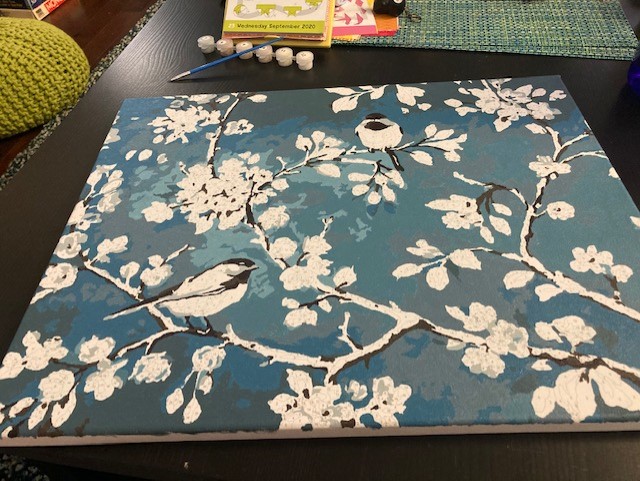
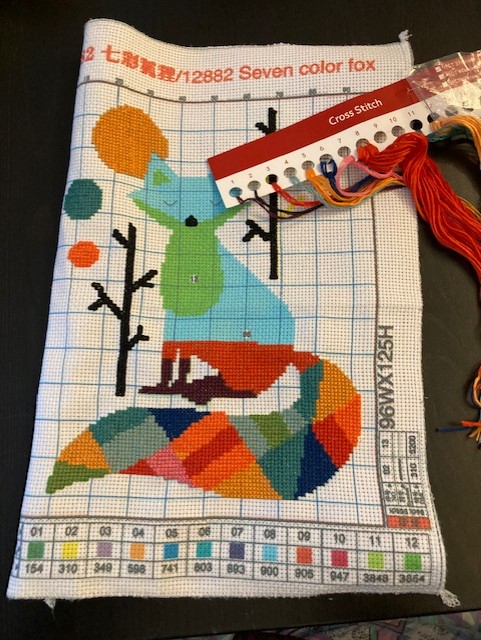
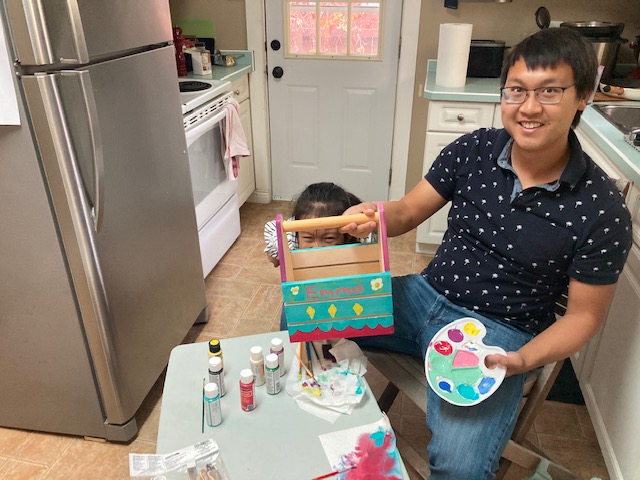
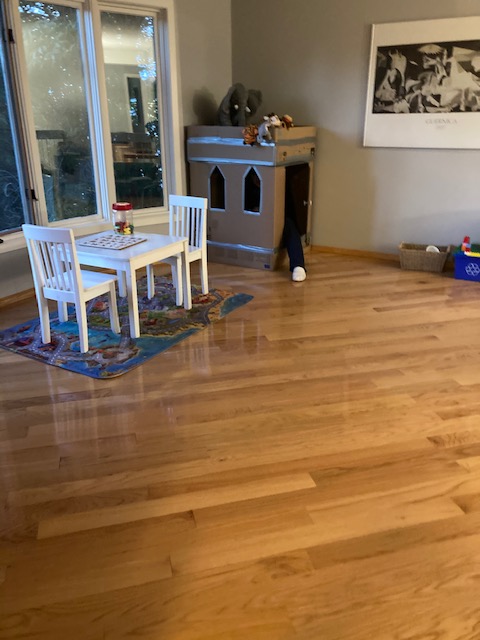
The art one, I chose to focus on discussing and presenting captions for them.
Doing the paint by number reiterated that doing art is a lot of work! Even without the design component the technical act of painting is involved. You have to have a strong sense of colour, the interplay of lights and form, and even just your physical hand. I really liked seeing how the look of the painting changed with every layer added.
Painting it also gave a lot of time to sit with myself, it was an active process but at times I got ‘in the zone’ and it really did feel meditative.
I chose to do a cross stitching project because its a craft in my own family’s history. My mother especially did lots of cross stitching passed on from her grandmother. As kids we spent a few summers cross stitching pokemon! Next time I enjoyed, it reminds of digital pixel art and mosaics in a way. Next time I think I have the confidence to do my own design though.
We had a ton of fun painting a basket with my niece, inspired by this process. She was happier with it this time because we drew our plan beforehand, learned from last time! She also was fascinated with even the paint water.
My brother designed and built this adorable castle for his daughter. She loves it, he loved it, and its repairable and memorable unlike an expensive store bought playhouse.
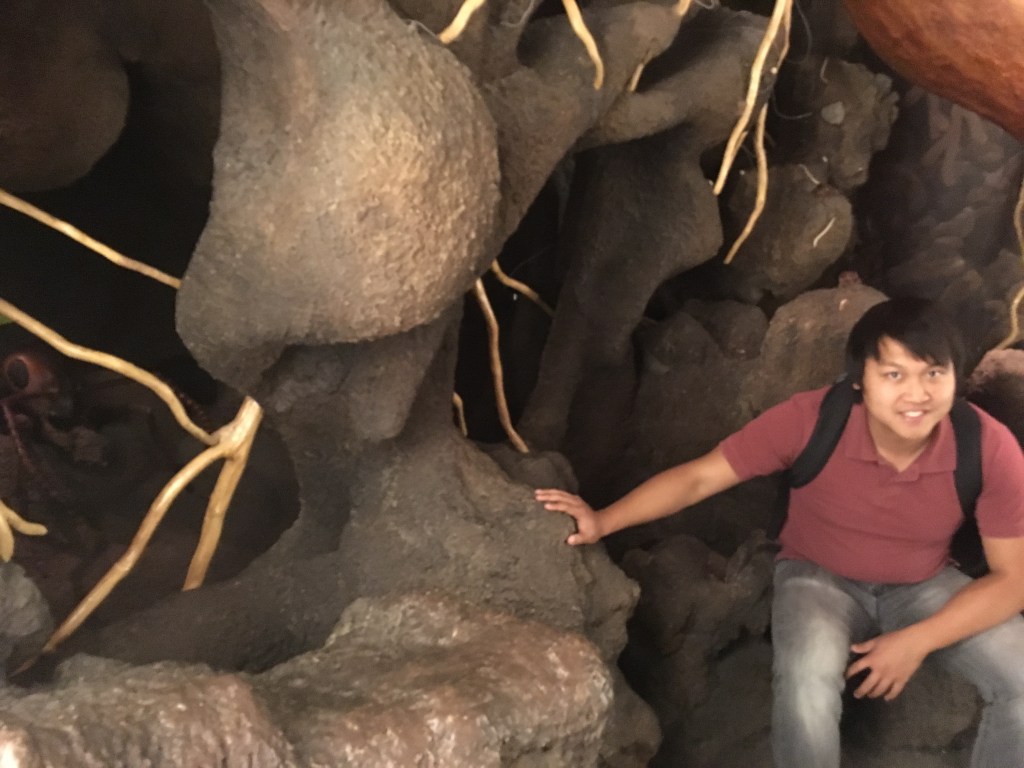
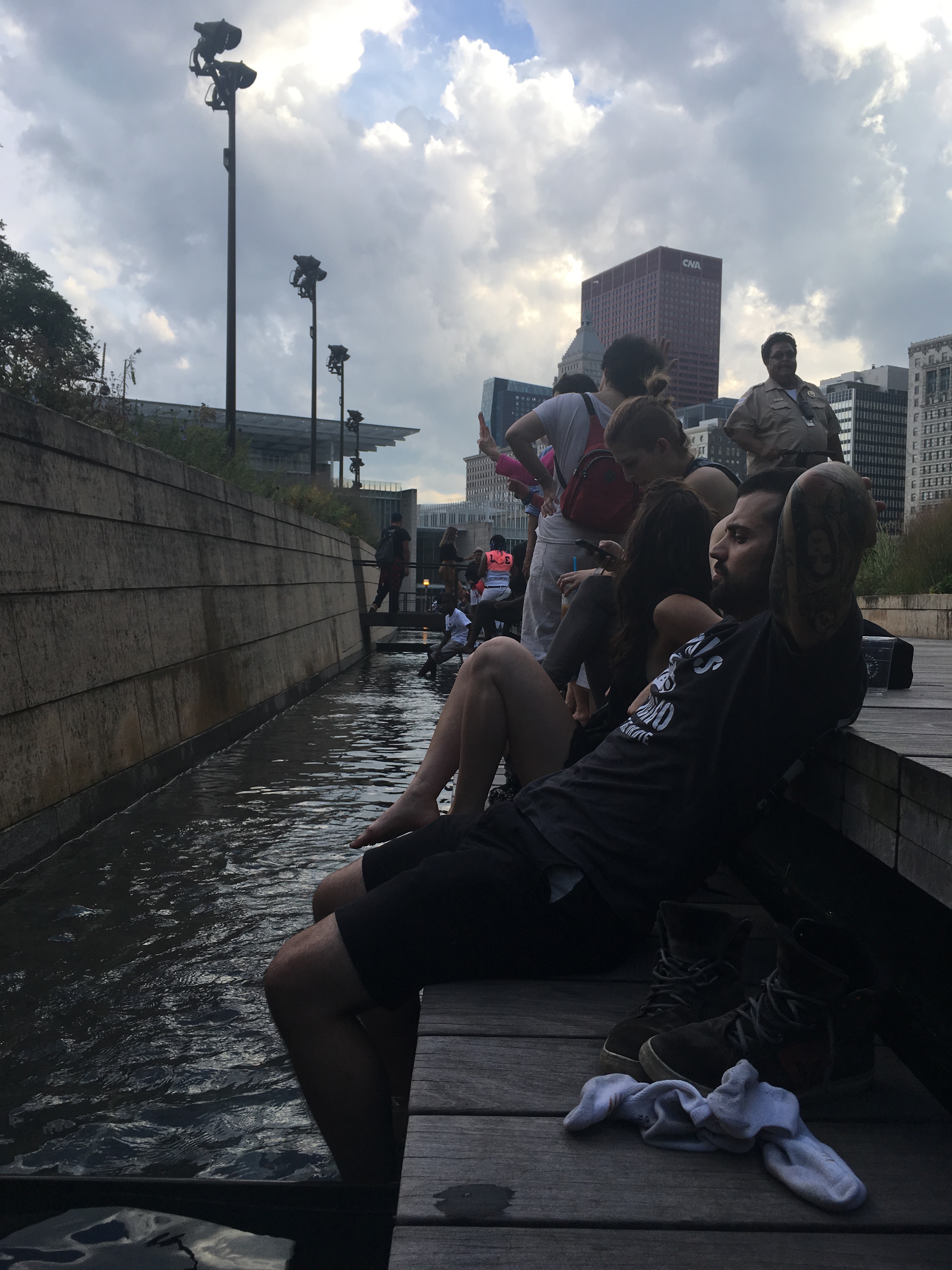
Science learning wise, I remembered an amazing exhibit I went to in Chicago (2018). They had a fully sculpted basement where you explored the ‘world of soil’ as an ant. Way more informative and fun.
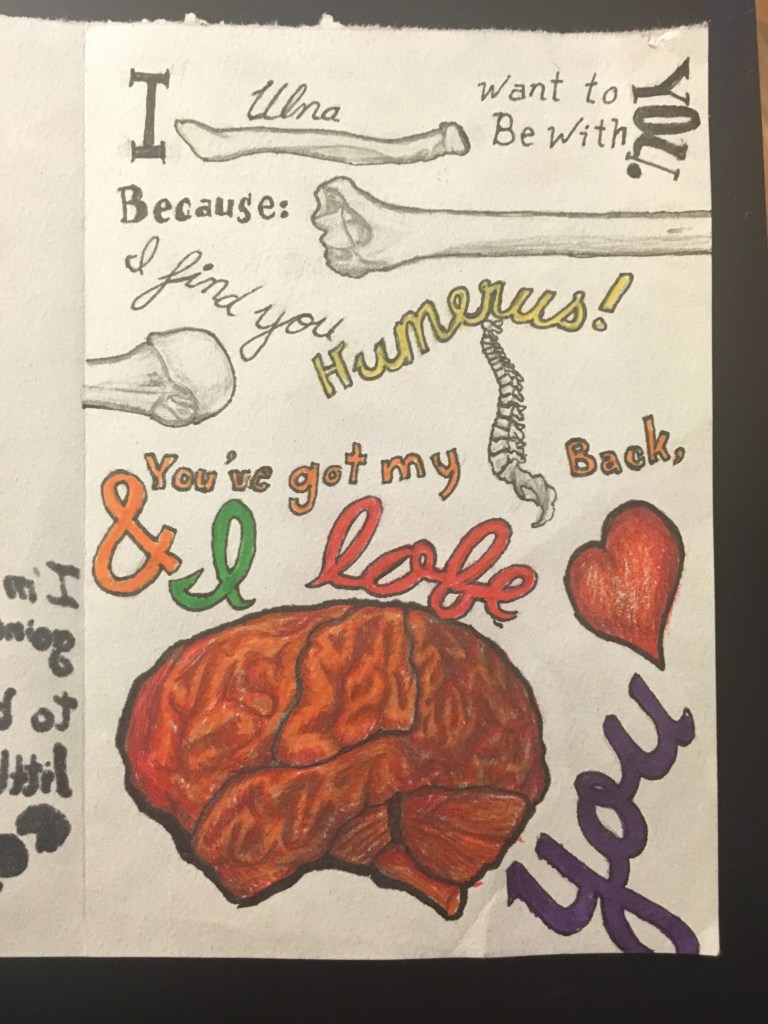
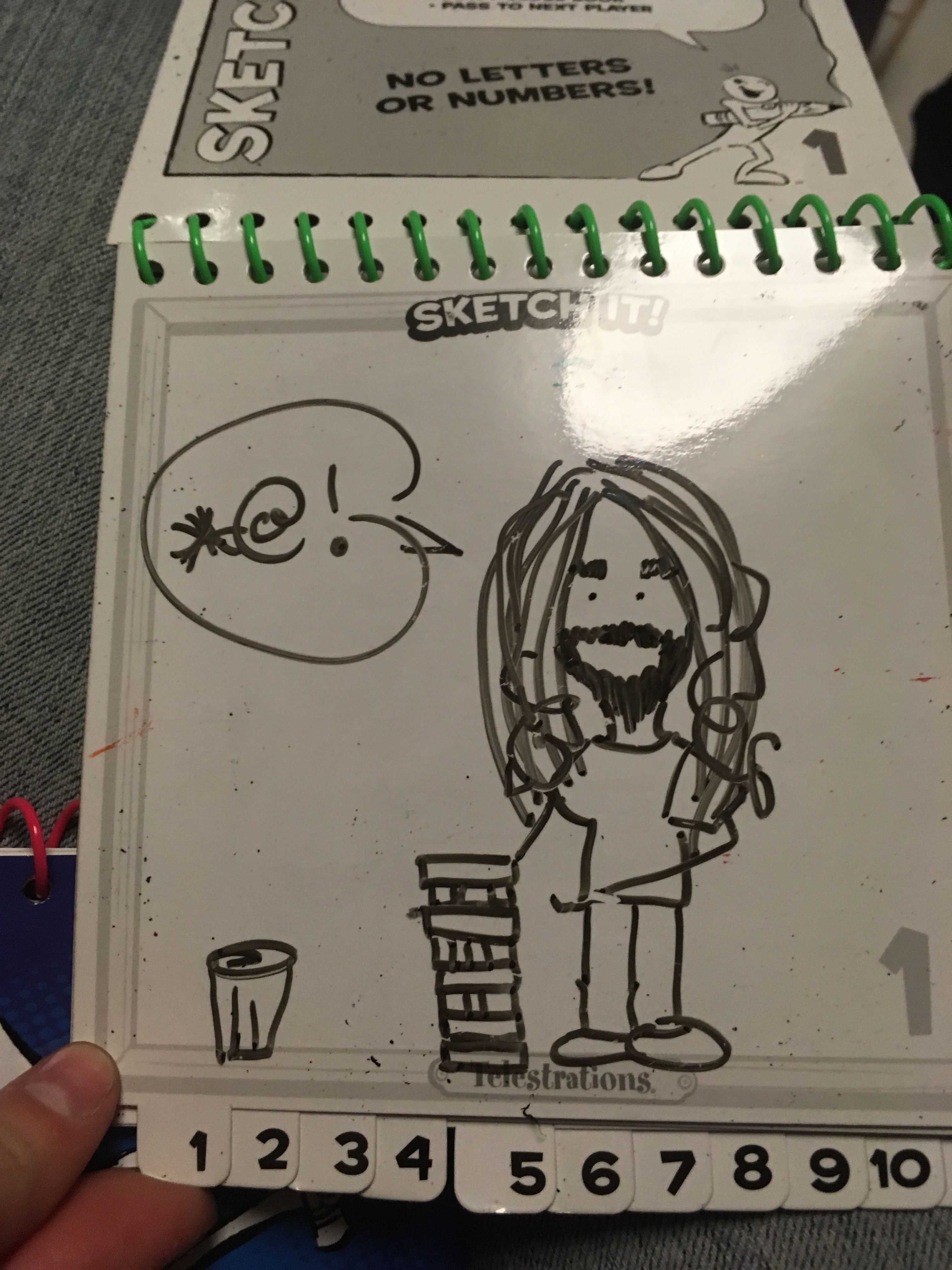
I also got to look back at some of the ‘cheesy silly’ things I’ve done in the past through a new lens. I’m actually pretty proud of this card, and my anatomical knowledge definitely helped support my weaker drawing skills.
I think making punny cards could be a good classroom activity!
I decided to try this a simply a Stream of Consciousness while reading Braiding Sweetgrass by RW Kimmerer. Rather than dwelling in the structure and meaning of my entry I’m going to instead focus simply on the stories shared and my responding to them as they come.
During my reading I felt a strong connection between both the 4Rs youth movement and Young’s Dis/Abilities paper. Both focus on developing critical literacy, though 4Rs is less explicit about this, and social activism in young people, though they have different focuses. Young focuses on dis/abilities and heterosexism whereas the 4Rs approach comes from the side of reconciliation. However, both appear to come to the conclusion that individual identity, safe environment, and meaningful communication are preqrequisites to meaningful social and crucial discourse.
Young focuses on developing the abilities of decoding language and message, connecting language and power, and critical analysis. The 4Rs focus on supporting introspection and self-evaluation in all students, guided and safe conversations, and “third thing”.
4Rs is an Indigenous and non-Indigenous youth give their perspectives, goals, and approach to reconciliation in Canada and social activism. Such a difficult topic and conversation, but the content of the site alone is an amazing window into the lives young people and how they relate to such serious topics. Beyond that they have a strong focus on platform, tools, leadership, and capacity building in young people that is both powerful and inspiring. Their focus on bridging the gap in reconciliation by developing strong individual identities and ‘connected/strong?’ diversity is a new approach to me.
I enjoyed the iterative and collaborative process that they have been following, especially is they were formed through the coalition of many existing your advocacy groups which formed the bedrock of their organisation. They have a clear and concise path towards there goal, by bringing everyone together on even-footing so that balanced and open discourses can take place amongst any young people.
They make a point of mention that many schools may not have visible diversity, and yet we must welcome and learn about diversity in every classroom. They’re discussion of privilege and diversity got me thinking about the fact that we all have our own unique positionalities. We have greater and lower levels of privilege in various spheres of our lives, even just by living in a democratic and wealthy country in Canada whatever our experience in this country might be. That said, we are also all lack privilege and have negative experiences as well. Especially in Saskatchewan there can be a disconnect from messages of anti-racism and critical discourse towards our colonially educated students. Through introspection and careful but difficult conversations we can support our students to bridge that disconnect as individuals and together.
This focus on looking inward and calm contemplation as a precursor to cross-cultural connection and critical analysis reminds me of a meditation initiative in California. The school started opening and closing everyday with 12 minutes of unguided meditation (after teaching the skill) in all classrooms. They found a great improvement in classroom management, attendance, and student achievement simply through giving students time to stop and breathe. Giving the space to simply be in their bodies as individuals and feel their own thoughts was apparently powerful in their school experiences.
I’ve been inconsistently dipping my own toes into meditation in the last few years and I definitely find it valuable. Again, it doesn’t always feel important or worthwhile when there’s so much going on, but I’m always happy when I do do it. Personally, I found that just listening the thoughts that arise without immediately assessing and addressing helped untangle my thoughts. Afterwards, I would feel both clearer mentally with a path ahead, but also physically calmer even when I hadn’t realised that stress had keyed me up.
I guess where I’m going with this is that I think many of us are disconnected from ourselves. We often don’t value ourselves as beings of body and spirit but rather solely for our contributions. In my experience, our society disregards the personal (identity, feelings, beliefs, hopes) in favour of the public (money, beauty, function, service). Its no surprise that when we don’t often consider our own selves as feeling, wishing, and hurting beings that its difficult to authentically do the same to others.
Going forward, I hope to try and integrate these strategies and values into my own practice for both my and my students’ development.
Datta is a really powerful writer, in an unassuming way. Much of his work is quite humble and the content is easy to comprehend. His paper on the community garden first interested me simply because of the environmental and local community connection it had but I soon found much more.
Firstly, his discussion of his own identity of an Indigenous Bengali man was eye-opening. Indigenous people all over the world face difficulties, but they also have great community and culture that we can learn from. Somehow hearing about his past opened my eyes beyond the story of the ‘annihilated and limping’ indigenous cultures living on life-support to look at the actual culture and people as a whole unto themselves.
Not to say that Canadian FNIM people are not struggling or that there are no impacts today, but rather that there are two stories happening here. One of the assault on FNIM communities and culture, and the second the story of those FNIM communities and cultures independent of outsiders’ interference.
His work also expanded my concept of ‘research’ by introducing me to the Participatory Action Research method which sets out to understand the supposedly ‘unquantifiable’. He sought to see sustainability through the lenses of the community gardeners. Datta did this by engaging and sharing in cultural stories, activities, music, and foods at the garden including sharing his own. I was impressed by how much he was able to learn about or ‘find out’ about sustainability and cross-cultural connection through this endeavor.
I personally surprised by how much more invested I felt in the paper just because it was local to me. In a way it relieved me of the burden of interpolating it to my experiences. I wasn’t stuck thinking ‘would that even work here?’, ‘that’s impossible because of our local environmental limitations’ and ‘Saskatchewan isn’t interested in these topics’ that I normally do with other social or environmental papers. But there really is wonderful things all around us at all times of year.
So often in both biology and education I’ve felt some options were not accessible to me because we don’t have enough people, we don’t have a warm enough climate, or some other thing but apparently that’s not true. This allow gave me the impetus to reassess some of my assumptions of my own life and home.
I think that following the strict definitions of ‘experts’, ‘knowledge’ and ‘truth’ that I’ve been brought up I limit both myself and my future students. Datta’s research does not fit into that model exactly, though it is still quite academically rigorous, and yet I learned so much from it. I’m excited to broaden my learning horizons to new people and to catch up on all that I’ve been missing.
From my own experiences, courses, and the readings I have a sense that the FNIM world-sphere has a greater appreciation for ‘non-traditional’ academic endeavors. I want to deepen my relationship ship with visual art both for my own piece of mind and for the sake of my future students. Knowledge itself is not attached to the written word as much as we may feel it is tied up in books. Students have all kinds of interests, experiences, and talents that they can use to interact with the world and express themselves.
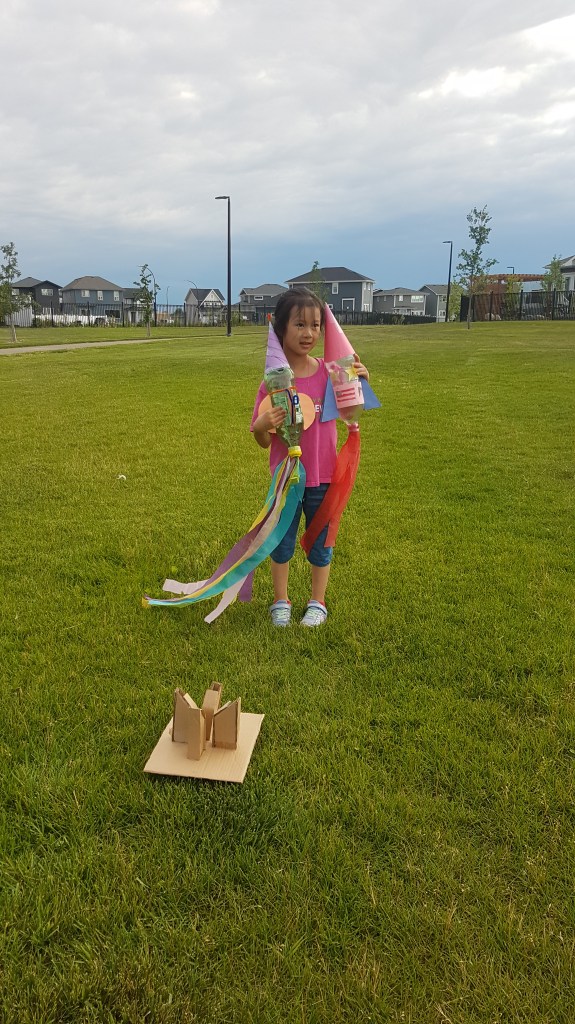
My niece with the bottle rocket we all made together.
We learned a lot about water pressure, when paper gets wet, picking up all of our garbage.
It was also fun watching the adults fuss over the little aerodynamic details of a hot glued bottle rocket.
She really enjoyed the decorating the most though!
Even in the working world I’ve found that little actually decision-making or problem-solving is done wholly through numeric analysis, even if only through additional oral discussion. There’s always interceding factors, relationships and more that influence, synergize/empower, and circumvent cold analysis. This is beneficial to businesses, employees, and the world because it is more flexible and responsive. Otherwise computers would be better at predicting climate, investments, and crime than they are now. Beyond that though, work isn’t/shouldn’t be the most important thing in anyone’s life, and personal lives rarely rely on cold hard facts if ever. Even financial decisions require judging the validity of information and predicting the future stability of non-monetary factors.
All this is to say, that while cold hard facts can be powerful, they are useless on their own and often not actually applicable at all when it really matters. I think it is important to be informed but as this year has shown us, we are still led by our heart more than information we’ve gotten from the ‘information age’.
I feel like my own culture, colonial European culture, has left behind lots of its traditional and aesthetic pursuits while running in the global rat race. For this reason, I’m hoping to learn more from other cultures, especially Canadian Indigenous cultures, about the role are can play in our lives and in our learning.
Through reading selection options, I developed my own personal goals. I think it consolidated many thoughts and concerns that I’d been having through my education school career but hadn’t had the time to explore in depth. I surprised myself with how clear and motivating I found my guiding principles. A broader appreciation of knowledge and expression supports connection.
I also clearly felt my own discomfort in these spaces, like I’d walked in on someone else’s family dinner. I felt that there was something wonderful and special there but at the same time I felt both and urge and push to leave? This isn’t something I fully understand myself, but its strength makes me thinks its something important to explore deeper. Personally, I don’t want to be beholden by an impulse that I don’t understand, trust, or know the source of, especially since it doesn’t seem to be serving any helpful purpose.
I think I have a blind spot and bias against the ‘unquantifiable’, that if it cannot be measured that it cannot be relied on and is therefore useless. I know conceptually that none of that is true or even accurate, many complicated and human things can be measured and many ‘facts’ are not measured honestly, this is simply a bias I’ve allowed to go unchecked.
In part I think this is defensive, this isn’t a part of myself that I’ve ever explored despite my personal interest because I didn’t feel it was acceptable or valuable to do so. I resented past experiences where, as a student especially, the message was to be creative but the reality was that your options were to slap paint on a pig (colour strict academic product), create a masterpiece taking many hours beyond the scope of the activity which ‘earned’ its right to be assessed as learning, or try and fail receiving comments that this creative endeavor doesn’t actually do what an essay would have done and therefore is useless.
To be frank, looking back, I’m not sure how many of these messages were even explicit or intentional. Maybe my own insecurity in my abilities read to far into the comments I received. Maybe my message was confused regardless of the creative liberties taken. But I sure that no major assessments or learning were done without concrete work shown on loose-leaf.
What does “teacher identity” mean to you? What does your identity look like at this phase in your career as a teacher?
My understanding of teacher identity changed in response to this course and the professionalism conversation that continued through the course and as I learn more about the history of teaching broadly and locally. At this point my identity is still very vague, I have a passion to bridge the gap between interest and understanding in science for my students but and just starting to learn of all the difficulties and frameworks that must be accommodated in order to bring good teaching to my future students.
How did the type of school I was in shape my high school experience?
My high school gave me a greater sense of trust in schools and belonging than I think most students experience. I went to Murray, a large and technical collegiate in the city which defined my expectations of high school. I was in what is now called SAGE which gave a consistent cohort of classmates for my main subjects but had a huge amount of options for my elective courses which were all well resourced. I think this allowed me to form a lot of connections to different people and find belonging despite being a weird kid (like all kids) without having to change myself.
I feel that this experience is one that not all people have, especially in smaller communities where options are limited, and the social sphere is much narrower. I must remind myself that bad experiences were not rare for everyone and that stereotypical terrible high school are not only in movies.
It was interesting doing these quizzes in class. My personal VARK was very biased towards physical and auditory learning with a zero in reading/writing which sounds true to my life. My MBTI profile was INFP, I kind of am a very intuitive and feeling person which is kind of interesting coming from a science background, I have feeling some of my friends may see me as more of a sensing person than an intuitive one based on my love of trivial facts, but agree that despite my understanding of a situation I always go by feeling.
Learning is complicated, but I see these profiles in my learning. I really thrive in discussions and questioning but cannot process verbal facts and figures for the life of me, but both are auditory. I always take notes covered in diagrams and arrows because otherwise I don’t fully process the information that I’m writing down so I fully accept my weakness in that area and hopefully can practice to improve it somehow.
I think my learning style would be helpful towards my students in that having a lower reliance on reading/writing it should be easier to adapt when there are ESL students or others where written instruction is not always easy, I also hope that by seeing the world through Intuition and perceiving I can bring more joy and curiosity to what could otherwise be fairly dry lessons. I hope this allows to create greater connections between my students and the content increasing their engagement. I do worry that I may end up giving confusing or incomplete written instructions or feedback which will be bad for students who rely on that information either from their own learning style or for practical reasons like accessibility or future reference.
The TPI gave me an average of 34 which I think shows I have some lofty goals for my teaching, and also that I’m consistent between belief, intent, and actions. This is easier for me to say now because I’ve only spent six weeks in a classroom, I’m sure as I continue my practice that things will change and focus. The exception being that I intend to, but do not act or believe in developing students knowledge from their point of view which is new to me. I am not surprised that I value apprenticeship learning and transmission of knowledge because that is my own preference for learning that I see as valuable. I think developmentally I had the perspective that wherever students are coming from they can gain some learning from any content if presented in the right way but that is something I will have to keep an eye on.
High school is a scary and exhilarating new step! I know you’re stressed so I’m just going to say remember that high school is still just a school same as elementary was, you’re smart enough to make it through! Although teachers and everyone take things seriously, this is the time that you’re allowed to be a confused and terrible person with less consequences. Take some risks even if things might not work out, both socially and in academics. Like everyone says, class is easier if you the homework a bit earlier, but I still haven’t mastered that skill so no tips from me. If homework is really challenging you talk to your teachers about it, its not an inherent flaw in yourself or difficult design on purpose so they can give you more insight than stressing a lone can do.
High school is only four years, but it is almost as defining and special as people say. Lot of new people and freedoms and growth while all your friends are constantly with you all day. That said you can’t really ruin or waste your high school experience being honest so don’t be too afraid to try new things or making mistakes. Even the confident people are full of hot air in high school, despite how certain they sound so don’t be afraid to speak up or question them.
When you get down to it, trust your own judgement more than your peers and listen to your own thoughts. Really just try new things sometimes, talk to people and you’ll be fine. I’m satisfied with the amount of daring, dumb things I did but wish I’d been more out there day to day with people. Looking back, I never let myself be in unsafe situations so being cautious was a not worth being embarrassed about because many people did end up making serious mistakes. My advice is just to keep an open mind but know that others don’t know as much as they think so don’t let them scare you. Also, don’t talk so much in class.