
These cases were written by Diane Clark for EPSE 348. I’ve included the assignment as well as my own responses to the assignment as it was a very interesting exercise, and I was happy with my efforts as well.
First Case
Analysis 1
1) Create 2 Learning Targets from the above outcome.
A) Students use integers drawn from a deck of cards to move their piece along a track, they may only move if they select the correct square (e.g. correctly move +3 or move an opponent -2).
B) Complete a worksheet of integer addition/subtraction with an emphasis on opposite integers (notice pattern of opposite integers equal 0).
2) Provide and explain 2 unique examples (not from the Case Study) of Formative Assessments based on the above information for the Unit on Integers.
A) Have students step forward and backwards tiles starting from a line on the floor in accordance with addition of positive and negative integers. First as partners stepping and calling and (then blind folded?), succeeding if they are on the correct tile at the end of the instructions.
Purpose: Develop understanding of positive/negative integers and practice their use symbolically.
Measurement: Have they correctly added the integers and counted the tiles to the right spot.
Evaluation: Accuracy, confidence in steps, speed of steps.
Use: Formative, practice, and diagnosis. Good for motivating student interest, visualising content, practice thinking of numbers as integers with positive or negative directionality.
B) Have students guess why we use the phrase “two steps forward, one step back”.
Purpose: recognise integers and use their own knowledge of integers to interpret the phrase.
Measurement: At least one full sentence and a reference to integers.
Evaluation: Show understanding that +2 + -1 = +1, logical consistency.
Use: Formative, create interest.
3) Explain how the “teacher-time” during Centres are a form of AFL.
It allows for checking of student learning one on one so that teachers can evaluate their level of understanding and mastery of knowledge to inform future assignments and lessons. Students are able to discuss their difficulties or further interests on the unit as well as update the teacher on how they’re personally feeling about the unit so far. As a teacher they are then able to prepare better assignments and lessons depending on student needs.
4) Provide and explain 2 unique examples (Case Study) of Summative Assessments based on the above information for the Unit on Integers.
A) Solve word problems (with diagrams) such as conclude how far someone has travelled along a road after going back forth various metres.
Purpose: Use integers, interpret ‘forward’ and ‘back’ as positive and negative integers.
Measurement: Underline integers, show work, circle final answer.
Evaluation: Method of solving, correctly values, accuracy.
Use: Summative, diagnostic.
B) Assign students a sheet where they have to ‘balance a cheque book’ with both simple whole number incomes and costs for a household. If they finish early, they can attempt to improve the budget by altering the various costs.
Purpose: Use integers in a concrete situation, interpret money as numbers.
Measurement: Correct monthly budget sum.
Evaluation: Accuracy, correct method used.
Use: Summative
5) Is Shawn motivated by Performance or Mastery learning?
Mastery, Shawn is interested in work beyond required for the grade and engages with the content after he has completed by assisting fellow students.
6) What accommodations or adaptations would you have made specific to Shawn (at least 3)?
A) I would give optional activities/challenges to assignments so he can continue to learn.
B) I would focus on giving other forms of detailed feedback beyond grades such as written and in class comments, so he is still understanding his progress.
C) I would give these as ‘bonus marks’ so that he can be challenged and get them wrong without having his grades suffer since he has achieved the outcomes.
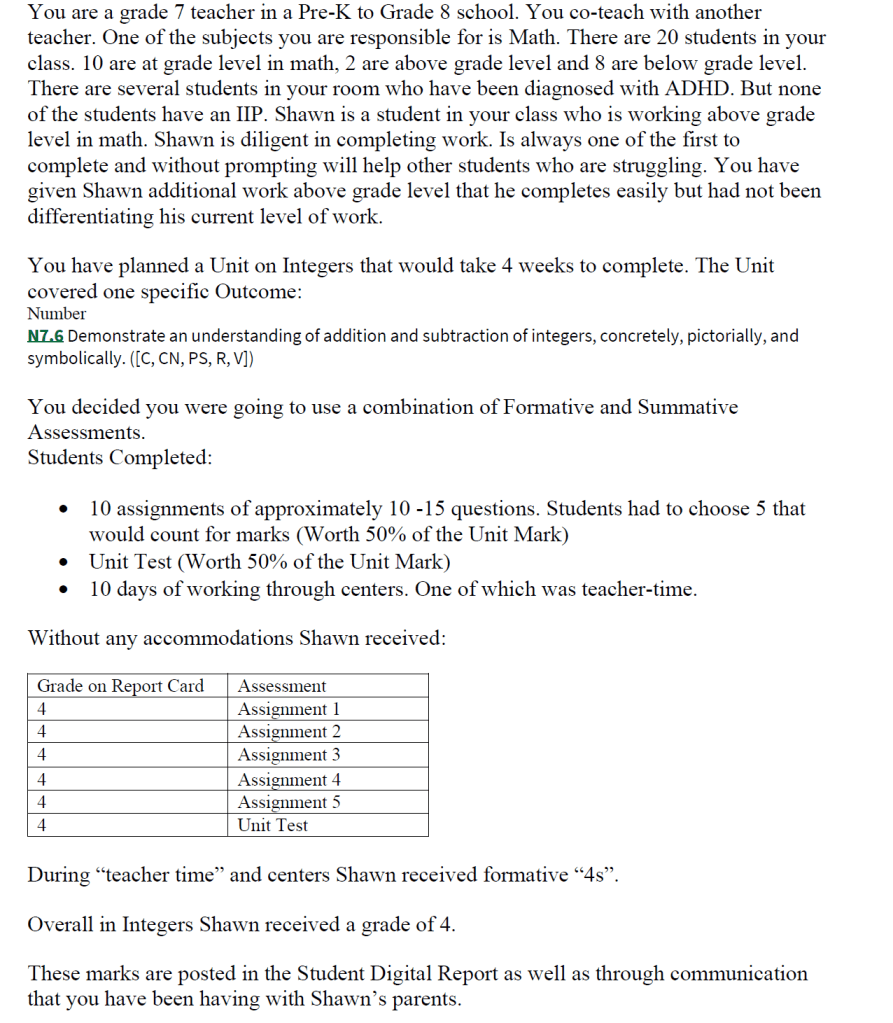
7) Would Shawn’s mark be different from the above Report Card? If yes, HOW? If no, Why not?
No, he has consistently achieved 4s throughout the unit. He shown clear understanding and accomplishment of the outcome throughout assessment. Shawn’s marks may not be as informative and meaningful to his learning as they might be to other students, but he has earned them.
7a) What final mark(s) would you give Shawn in this Unit and why?
I would give him 4, mathematically and scholastically this is the mark he has achieved. It is an accurate reflection of him meeting the curriculum outcome and therefore there is no reason to change it, there is not mark higher than four.
8) Are you using norm referenced or criterion grading?
Criterion grading, there is no value in trying to compare students, especially in this case it may drive down others grade unnecessarily.
9) Discuss how the 4 Components of Classroom Assessment were/were not attained.
I think that there is evidence of all four components of classroom assessment in this class.
Purpose: It is hard to know but it appears that the assessments must be purposeful as their a variety of them which shows care, students being able to choose only 5 out 15 assignments is best served if all of the assignments are relevant to all of the outcomes. This unit only has one outcome so we can assume that that is true but there are four different formats in that outcome which should be considered.
Measurement: Learning was measured through assignments, a test, and ten centres that we don’t get a lot of details about but seem to be diverse. There may have also been questioning during the lessons and other forms of informal measurement as their comments on student activity such helping others.
Evaluation: Presumably, evaluation is focused on correctness of assignments, although marks can also be based on methods used and speed (though that is not best practice).
Use: Besides the centres they were all summative assessments, though the assignments should have also informed the teacher as the unit progressed depending on their completion date.
Second Case
Analysis 2
1) Create 2 Learning Targets from the above outcome.
A) SCI10-CD4 Label a diagram of the biogeochemical cycles and their feedbacks from a word bank
B) SCI10-CD1 Discuss the impact of the school and it’s activity on the local ecosystem (including it’s construction) .
2) Provide and explain 2 unique examples (not from the Case Study) of Formative Assessments based on the above information for the Unit.
A) SCI10-CD3 – In groups explore and discuss the patterns of biodiversity they can find on the school grounds including weeds. Draw/describe two biodiverse organisms (plants etc.) and state a pattern to their lifecycle (e.g. grow in sidewalks and dry places).
Purpose: Examine biodiversity in person and work to discover patterns in communities.
Measurement: Engagement with activity, distinct characteristics of organism, reasonable assessment of community pattern.
Evaluation: Completion, two distinct details per organism, a personal observation and evaluation of organism to find pattern.
Use: Formative, diagnostic and body break.
B) SCI10-CD1 Find a news report on a local or provincial environmental issue and discuss in groups what and why that is happening.
Purpose: Discover the implications of human activity on local ecosystems.
Measurement: Article relevancy, understanding of issues discussed.
Evaluation: Article selection shows understanding of issue and what is relevant to the discussion, participation
Use: Formative, student analysis and check-in on their comprehension.
3) Explain how “daily group conferring” is a form of AFL.
It allows for the gathering of evidence of student learning through their discussion, teachers can evaluate their level of understanding and mastery of knowledge to inform future assignments and lessons. By occurring daily students become more comfortable with the activity and the teacher has a very up to date understanding of what lessons have been successful and where each student needs to go.
4) Provide and explain 2 unique examples (not from the Case Study) of Summative Assessments based on the above information for the Unit.
A) SCI10-CD4 – Create a picture/narrative/diagram/essay which illustrates one completion of a biogeochemical cycle and its feedbacks as completed in class, excluding the water cycle (water cycle example given). Write at least 75 words in some way on why this is important to ecosystem stability.
Purpose: Fully examine a biogeochemical cycle and its role in the larger ecosystem
Measurement: Meets all requirements, complete cycle is presented as logical series of consequences and major impacting factors are included. Clear illustration of how the cycle creates stability. Written component is accurate, concise and uses correct terminology where applicable.
Evaluation: Rubric of the above qualities emphasising inclusion of factors and their relationships.
Use: Summative, assignment will be a major component of unit mark.
B) SCI10-CD2 – Students will conduct an experiment that illustrates the green house effect by using heat lamps on two bottles of water, one of which includes baking soda which will release CO2 and heat faster. They will fill out a simple lab report inclu
ding methods, a temperature data table, and a concluding paragraph.
Purpose: To understand the impact of greenhouse gases and connect physical and chemical phenomenon to each other in person.
Measurement: Completion of lab report sheet as described above
Evaluation: Lab report conclusion includes discussion of ‘green house gas’ and the importance of the baking soda to this experiment, as well as overall completion and accuracy.
Use: Summative, hands on experience, lab safety, connection from lecture to life.
5) Is Joelle motivated by Performance or Mastery learning?
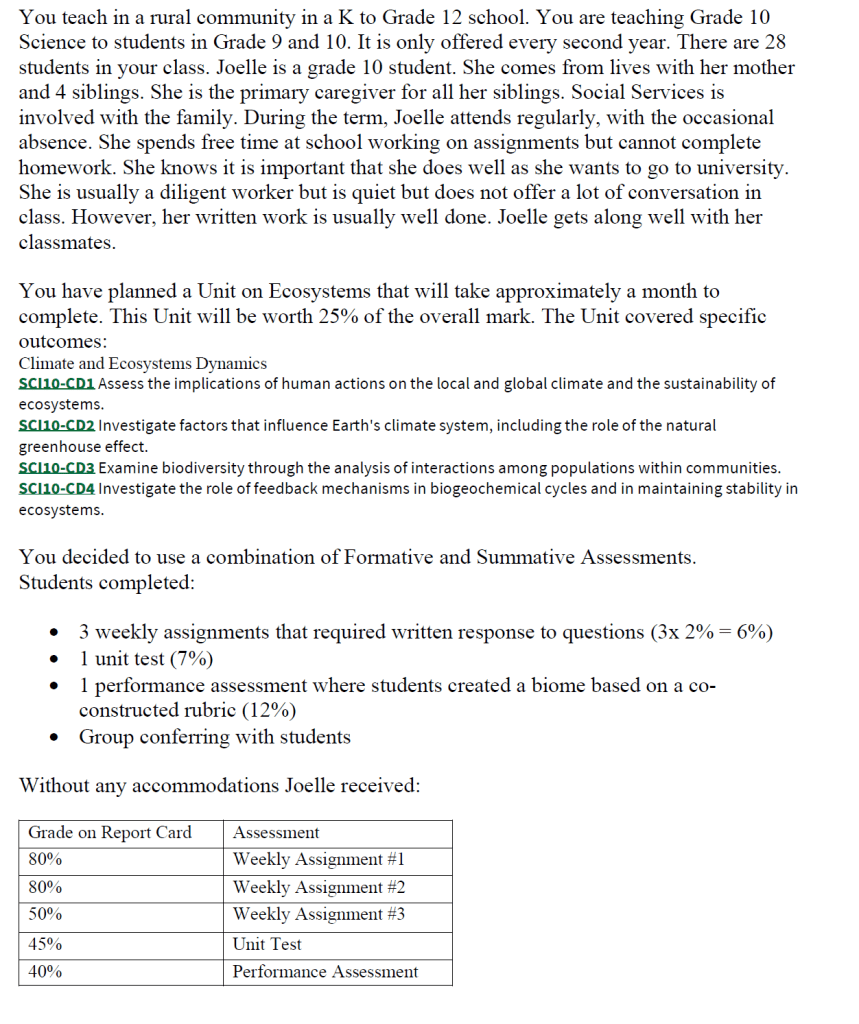
It is not as clear because she seems to be motivated by university acceptance, but her continued work despite recent poor grades would indicate a mastery motivation.
6) What accommodations or adaptations would you have made specific to Joelle (at least 3)?
A) I would have discussed her performance after the first low mark (assignment #3) to see what kind of difficulty she is having with assignment (time, space, focus etc.) and worked with her to find solutions to that for the future assessments.
B) I would have offered extension of the due date if she needs more time to work on them in school, since it seems she is unable to do so at home.
C) I would consider altering the weight of the components to reflect the differences in difficulty of her situation through the month, assuming outcomes were covered throughout the assessments or marking components of the larger assignments in chunks.
7) Would Joelle’s mark be different from the above? If yes, HOW? If no, Why not?
Yes, hopefully through accommodation her marks on the later assignments would be improved to at least 3s. Her earlier work shows that she can complete the work to a higher standard and there is no reason to think that accommodation and teacher support would not allow her to reach that standard for the other assignments. Retroactively deeper evaluation can hopefully focus on where she demonstrated her learning of the outcomes and maybe reduce superficial/irrelevant places that marks were placed. Depending on the evaluation done these changes may need to be made to the rest of the class (except the co-created rubric).
7a) What final mark would you give Joelle on the Unit and why?
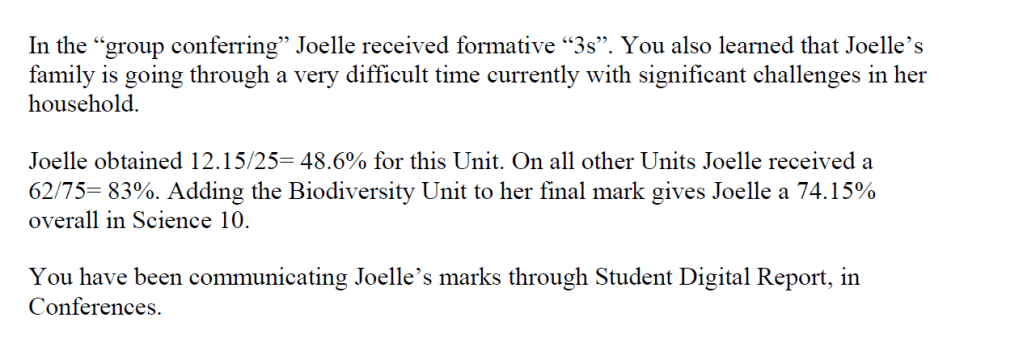
Depending on the outcomes the assignments cover I may consider dropping portions of the unit test / performance assessment which she had earlier shown understanding of, this may increase her mark. I would also adjust the weights of the assignments to include marks for the group conferring , although it had been intended as formative assessment and she is quiet she may have been better able to demonstrate her understanding in that format as opposed to the other assessment considering her personal situation. My changes would bring her mark up to 13.95/25 = 55.8% which would bring her final mark up to 75.95%, I’ve shown the changes in the table below.
| Without any accommodations Joelle received: Grade on Report Card | Assessment | Original Weight | My Adjusted Weight |
| 80% | Weekly Assignment #1 | 2% | 2.5% |
| 80% | Weekly Assignment #2 | 2% | 2.5% |
| 50% | Weekly Assignment #3 | 2% | 1% |
| 45% | Unit Test | 7% | 5% |
| 40% | Performance Assessment | 12% | 10% |
| 75% | Group Conferring | 0% | 4% |
| Final Unit Grade | – | 12.15 | 13.95 |
7b) What final mark would you give Joelle overall for Science 10 and why?
As discussed above I would give her a final mark of 75.95%. The unit cannot be dropped from her mark because we must assess her mastery of the four outcomes of the unit but the original assessment may not accurately reflect her mastery either when compared to her learning in class. Overall this is not a large change but hopefully it will motivate her to continue her efforts in class and make her feel her situation is being seen so she can bring up future issues as they arise.
8) Are you using norm referenced or criterion grading?
Criterion, there is little value in comparing students to each other rather than the curriculum outcomes and how they have achieved them.
9) Choose 3 steps of High-Quality Assessment and discuss how you might use them during this Unit.
A) Practicality and Efficiency: I would place a greater emphasis on assignments that can be completed in class. Check if there are unnecessary requirements and ‘bulk’ such as in-depth writing or irrelevant questions which focus on effort rather than the outcome. More efficient assignments best utilise students’ time and motivation.
B) Positive Consequences: Bring energy and interest into the classroom through engaging and fun positive consequences made available to students through a variety of ways.
C) Clear and Appropriate Learning Expectations: Be sure that the learning expectations are very clear and explicit so that students can prepare themselves for the semester ahead and best focus their efforts to relevant work. This will all provide guidance and a path/workflow to students who may have less focus or ‘bandwidth’ for the practicalities so they can focus on learning.
 Baumann Teaching