I tried to present without a formal presentation, focusing on my visual products and oral narration but it was nerve-racking at the start. It was a test to stay focused and clear but I enjoyed the fluidity and felt more energised while presenting.
Presenting the various aspects of my learning was hard, especially trying to explain the sources of my understanding without common context while still driving towards a point.
While presenting I learned the importance of clear background and objective. One classmate didn’t know I wasn’t an art specialist until they asked afterwards, so I imagine some of my intention was missed because of my vagueness.
Presentation of Learning
Objective: I wanted to broaden the scope of my perspective and teaching practice. Background: 1) I graduated awhile ago, my teachers were innovative but most lessons and assessments were lecture and essay/test focused. 2) My family enjoyed creative activity but the expectation was to strive for a financially safe career, art and other endeavors would have required significant artistic talent. I did not know what to do with the Katilvik Inuit art website and I did not like that limitation. 3) My career in ecology and microbiology focused on quantifying nature into data. This data was then analysed to remove any irregularities and confidence assessed before even proposing and theory or explanation. Problem: In my experience, most people love scientific trivia and notice patterns of phenomena. Also, most people don’t think they are good at science and they can’t see it in their everyday life. These concepts seem to be dissonant and I’d like to bring more people’s experiences and ‘science into harmony. Proposed Solutions: 1) By incorporating broader ways of knowing and relating to the world around us I can approach teaching scientific concepts with greater diversity and relevancy. 2) By increasing my experience and confidence with oral history, storytelling, Indigenous traditions, and visual art I will be better able to incorporating these elements into my planning and meaningfully assessment them for my students. 3) By striving to improve my understanding, expand my skill set, and evaluate myself I am progressing as a lifelong learner. Hopefully, starting these habits now will hopefully continue those habits through out my professional practice and beyond. 4) By exhibiting openness to different perspectives, methodology and conventions (language etc.) I can invite more people to engage with the world around them and science with confidence.
Learning to appreciate the world through Indigenous ways of knowing and seeing is a lifelong process which I, as a white person, will never master. None the less, I’m so happy to have gone on this journey starting with Katilvik and Idlenomore, to my classmate Janice O’s tobacco teachings, RW Kimmerer’s book, and further on into the future.
I feel that I’ve really broaden my scope of ‘learning’ and expanded my comfort zone as well. Reading Braiding Sweetgrass, which so expertly weaves both biological and Indigenous perspectives, and listening to elders like Bertha Skye share their knowledge, has given me the opportunity to hear from true experts. Living in this age of reconciliation, decolonisation, and global communication is truly a gift. While basic searching can give you a sense of what two eyed seeing means, only by listening to people who truly live this was I final able to fully connect to it. I’m feeling much more confident in my ability to learn from knowledge keepers and incorporate Indigenous knowledge and practices into my own teaching practice.
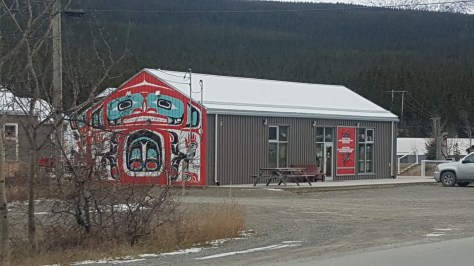
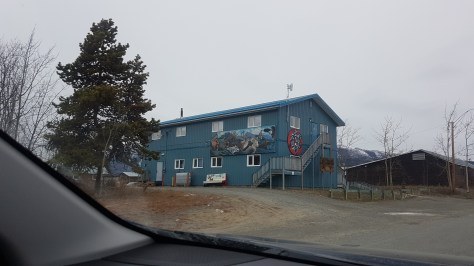
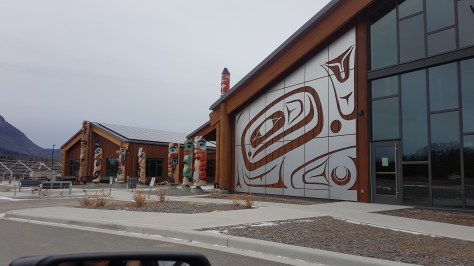
Driving through the Yukon between Whitehorse and Carcross Tagish, I felt the beauty of the land and the beauty of the people. The was art on buildings, public and not, showing the influence of local artistic traditions. The bold colours, shapes inspired by wood carving, and strong themes of nature. The peoples values and vision were stamped clear for all to see, giving a sense of place as well as pride.
What was interesting to me was that when I went to double checking locations in google maps, most of these were not photographed. They must be newer than 2005, and indeed some of the buildings even were not yet present. I’m impressed and lucky to see such active efforts and creativity in those communities.
Carcross Visitors Centre
Carcross Tagish Learning Centre
I was also amazed to learn, from another classmate, about Carcross’ incredible Science 10 program. The video below is from the two eyes seeing Facebook page which presents lessons teaching through both Indigenous knowledge and Western Knowledge traditions. This reinforced to me that community, learning, and art support and feed one another. This community really inspired me and I hope that I’ll be able to properly visit and learn from local peoples when this pandemic is over.
A new science class is being held outdoors near Carcross, YT. It incorporates Indigenous culture and traditional knowledge — and offers the equivalent of a Grade 10 credit in just 10 days.
I was also lucky enough to visit the North End Gallery in Whitehorse this fall. Although I was not allowed to take picture of my favourites, I enjoyed spending over two hours in the small gallery. There was a mix of carving, prints, decorations, and more from various Indigenous and non-Indigenous artists to view. Some of my favourites were Amber Church, Emma Barr, Richard Shorty, and Mark Preston to name a few.
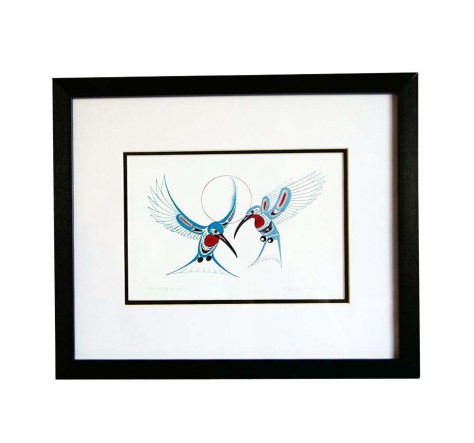
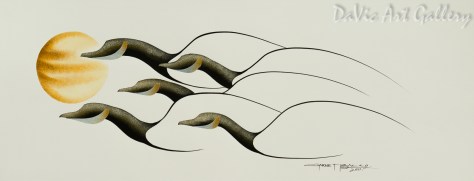
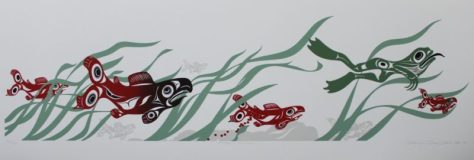
I was able to see, and sometimes feel, the craftsmanship and vision that went into each piece, creating beauty and inciting reactions. I was better to understand the descriptions from the Katilvik website regarding bold colours, representing nature, and loose delineation between subject and setting.
Raven brings Salmon by Eugene Alfred
Hummingbirds By Richard Short
Family Flight by Garnet Tobacco
Fragile Balance by Mark Preston
To finally do my own project, I had considered doing lacemaking. It would not be appropriate for me to work from an Indigenous art tradition, as it is not my own, so I tried to find one from my own culture. I settled on lacemaking, I remember doilies, Madeline novels, and historic dress from Western Europe so I wanted to try my hand at the craft. As you’ll at the 0:50 second mark below, that was biting off more than I could chew. I found further crafts of needle lacemaking, and tatting which were more common as handicraft than artisanal bobbin lacemaking but I still need more practice.
Belgian Bobbin Lace Making Demonstration
What I was struck by was the number of older people venturing onto the internet explicitly to share there own traditional techniques. Many of the terms they used where familiar to me from other contexts (whip around stitch) and the patterns were also not new either. These crafts are fading even from European cultures, presumable in part because they’re not commercially viable or entertaining enough to learn. But listening to people who sound and look so much like my family sharing the story of so many traditional objects (wedding dresses, christening gowns, décor etc.) gave me a great sense of connection.
The grief that must be felt by so many communities who lost all of that is staggering. I truly believe that we as educators, and as Canadian citizens, must do everything we can to support the revitalisation of FNIM cultures, traditions, and communities that Indigenous people are undertaking across the country.
This includes both historic crafts and present day efforts as well. We must also support political and young art such as the art from Idle No More. The Indigenous people of Canada are living, breathing, and here as their stories continue on.
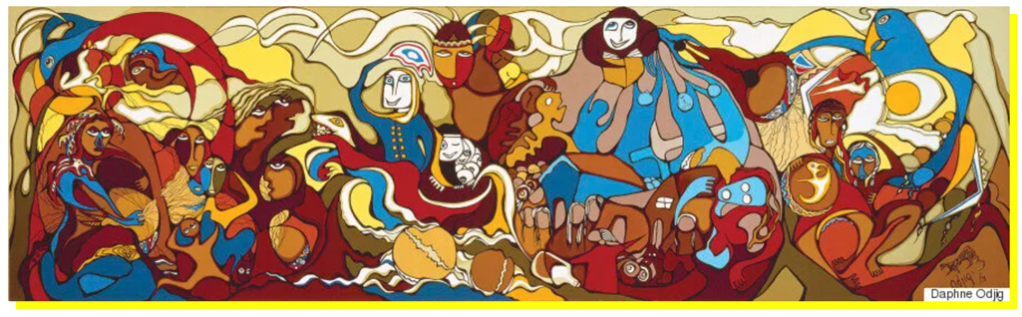
“The Indian in Transition” is a mural that was commissioned by the Canadian Museum of Civilization. It reflects the history of Indigenous people from before contact with Europeans, through centuries of colonization. A mythic Thunderbird watches history unfold from above.
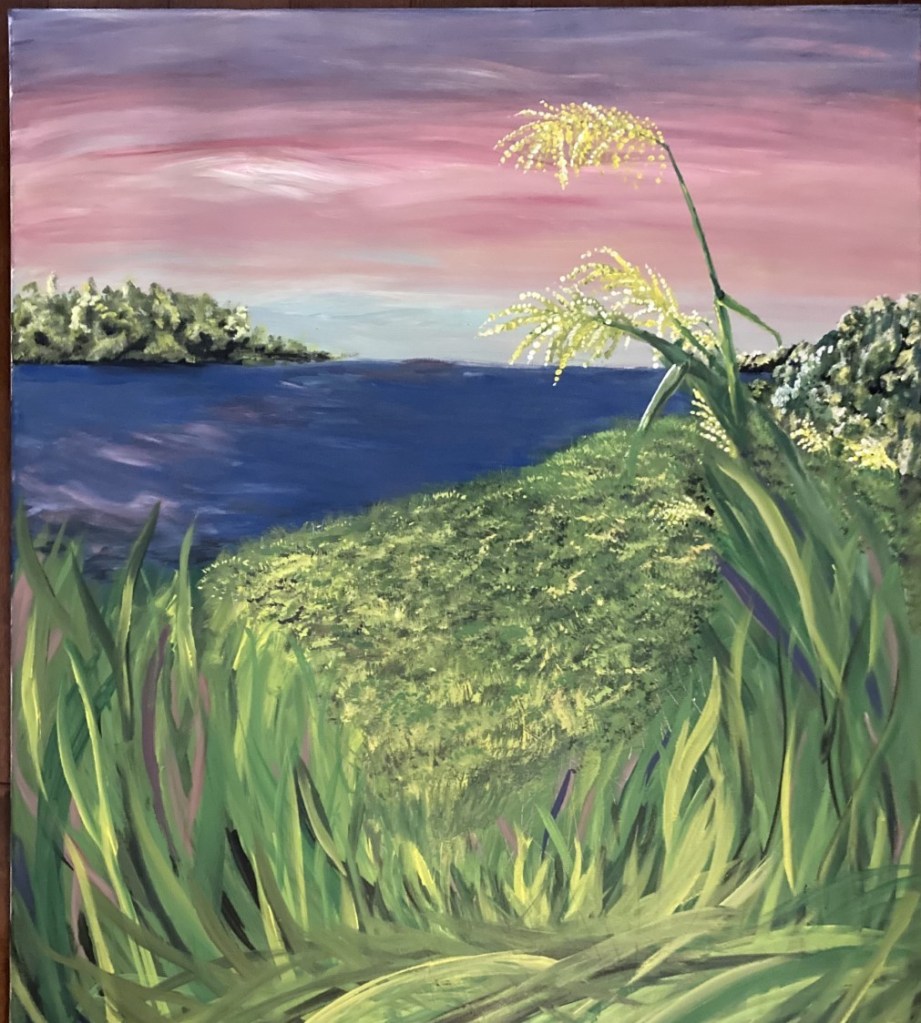
When I first planned to do this painting, I pictured some intricate multi-media piece that touched on all of the major threads from my learning. It would have the image of some journey, show art technique moving from paint by number to individual, incorporate some of the lacemaking or handweaving, and connect to knowledge and science through botany, grasslands, and beauty.
I had a lot of sketches for a concept, some I like a lot, but they just wouldn’t come together. I’d tweak them or make a new one as I finished a reading or did some reflecting, but nothing was working. Finally, I think in part because of reading Braiding Sweetgrass, I tried to take a broader and more grounded view of my learning in the last few months. I thought about what the point was really and what I wanted to share. I realised that my original concept was too convoluted for one painting, any one idea had merit but not together.
There was a lot of really valuable learning I did this semester but not everything needs to be shown in this one product. Through both the readings, assignments, and lecture content I’ve gained a better understanding of the value gained through learning beyond what you can report at the end. RW Kimmerer discusses trusting the learning of others and valuing their journey on top of what they can state on demand. So, in light of the pre-existing journaling, discussions, and presentations, I’m going to distil my main thought into a simple scene.
I decided to focus my piece on my own experience when I try to feel connection to my homeland, and how I interpret it as both a scientist and a local. I’ve lived in Saskatoon pretty well all my life but spent my summers at an old cabin by a small lake with my family. We knew most of the people there, and who are still there, but the park was large enough you could always find quiet. It was so far out of the way it didn’t even have radio and almost no one bothered to keep track of time. To occupy myself under the long summer sun I would read, listen to birds on our deck, or just wade in the water for hours.
That place is peace to me, I always feel safe. I knew the people, the trees, the weather, and could identify most happenings just by sound. Looking back, I’m so lucky to have gotten to know a place so intimately and feel so certain about where I was. What I learned from Kimmerer was that by being there I was also part of what made that place what it was. That quiet, unshakeable connection is still powerful in my life. I cannot go as often as I could as a child; little has changed there, little that mattered at least.
I painted the view from an empty hill, far but not isolated from people. The water is calm reflecting the gently pink dusk that lies opposite the blazing sunset. In the foreground is the colourful, long, uncultivated grasses which have been trodden on and bent. My intention was to place the viewer in the scene, showing were their body has been to sit and enjoy this view. Because humans are from the earth like everything else, and there is effect and interaction reciprocally between us and the earth. This can be loving and positive if we strive to make it so.
I’ve included the colours of some native grasses beyond green and I also did my best to stylise Calamagrostis canadensis, or Bluejoint Reed grass, which is an eye-catching native of Saskatchewan. I chose grass not only because it grows well, or better, with such disturbance but because of its importance to us here generally, and my own career personally. It’s the ‘bedrock’ of our economy now, the sustenance for the bison then, and the original coloniser following the glaciers which flattened Saskatchewan in the first place.
I’m lucky to have had the experiences I did, and privileged that my family was able to come here, stay there, and share all of our history with me. These threads shape who we are, our community, and our sense of self. These same threads in the first peoples of this land were deliberately torn apart through systemic government action and individual acts of oppression. However, those threads are not all broken or lost. There is so much to be gained by valuing the land, our relationships, and our journeys to support our students in weaving their own sense of connection and peace as they live their lives. I cannot handout these things, but I hope that by showing gratitude to that place and sharing my experience through art I can help some how.
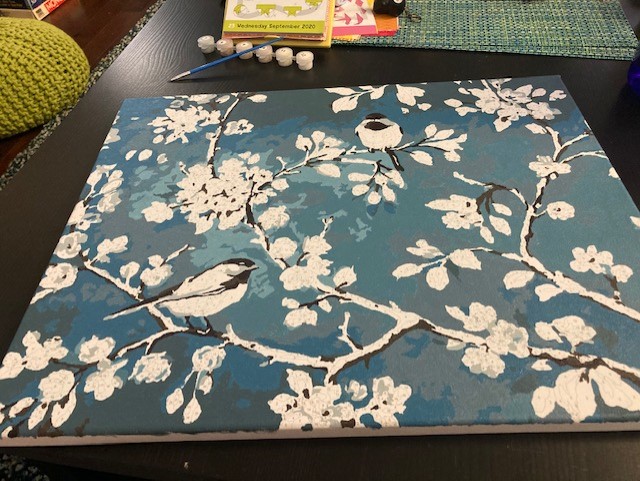
The art one, I chose to focus on discussing and presenting captions for them.
Doing the paint by number reiterated that doing art is a lot of work! Even without the design component the technical act of painting is involved. You have to have a strong sense of colour, the interplay of lights and form, and even just your physical hand. I really liked seeing how the look of the painting changed with every layer added.
Painting it also gave a lot of time to sit with myself, it was an active process but at times I got ‘in the zone’ and it really did feel meditative.
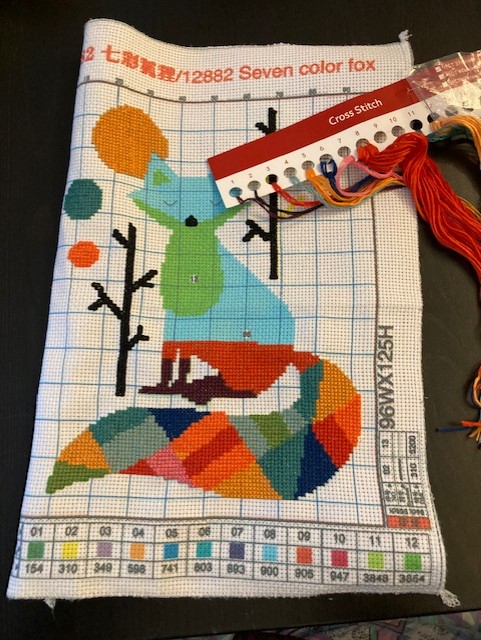
I chose to do a cross stitching project because its a craft in my own family’s history. My mother especially did lots of cross stitching passed on from her grandmother. As kids we spent a few summers cross stitching pokemon! Next time I enjoyed, it reminds of digital pixel art and mosaics in a way. Next time I think I have the confidence to do my own design though.
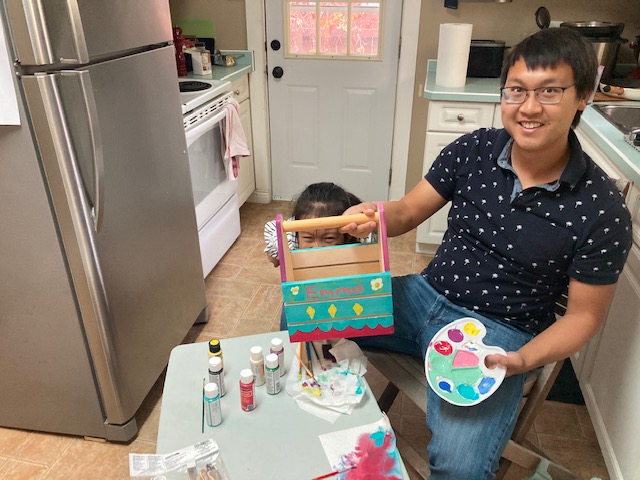
We had a ton of fun painting a basket with my niece, inspired by this process. She was happier with it this time because we drew our plan beforehand, learned from last time! She also was fascinated with even the paint water.
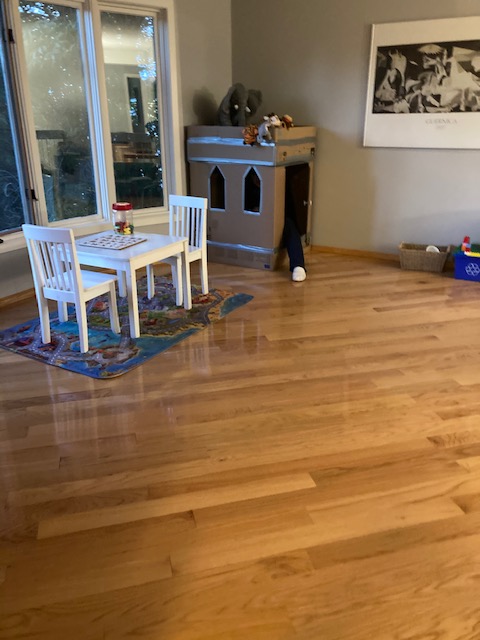
My brother designed and built this adorable castle for his daughter. She loves it, he loved it, and its repairable and memorable unlike an expensive store bought playhouse.
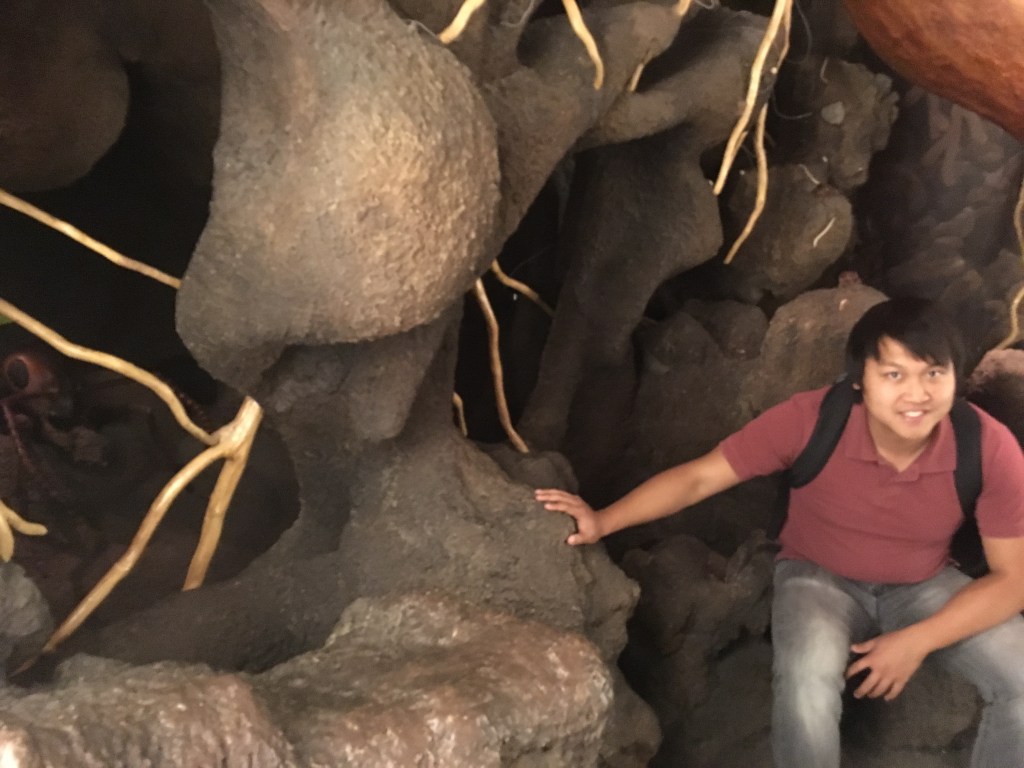
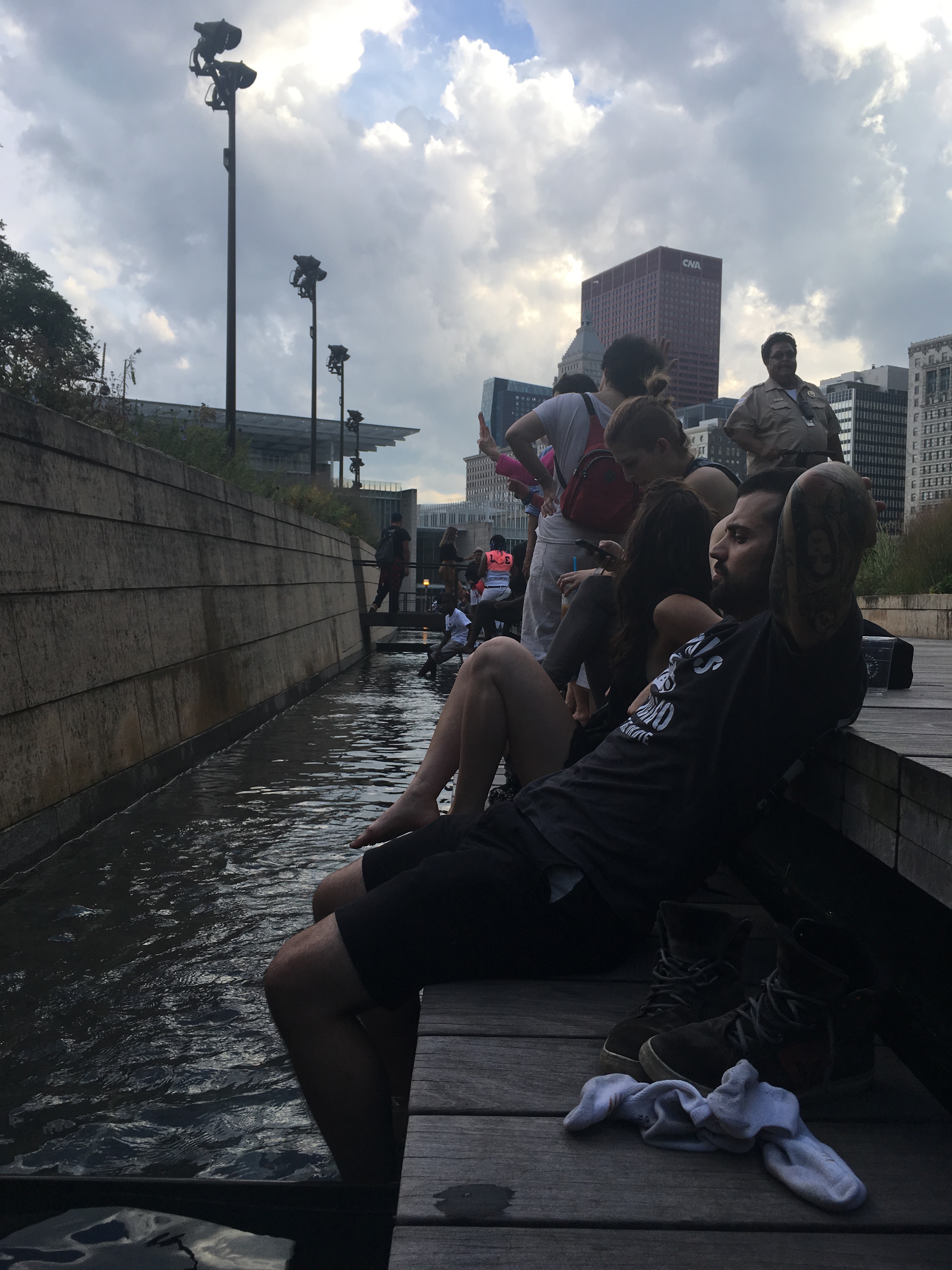
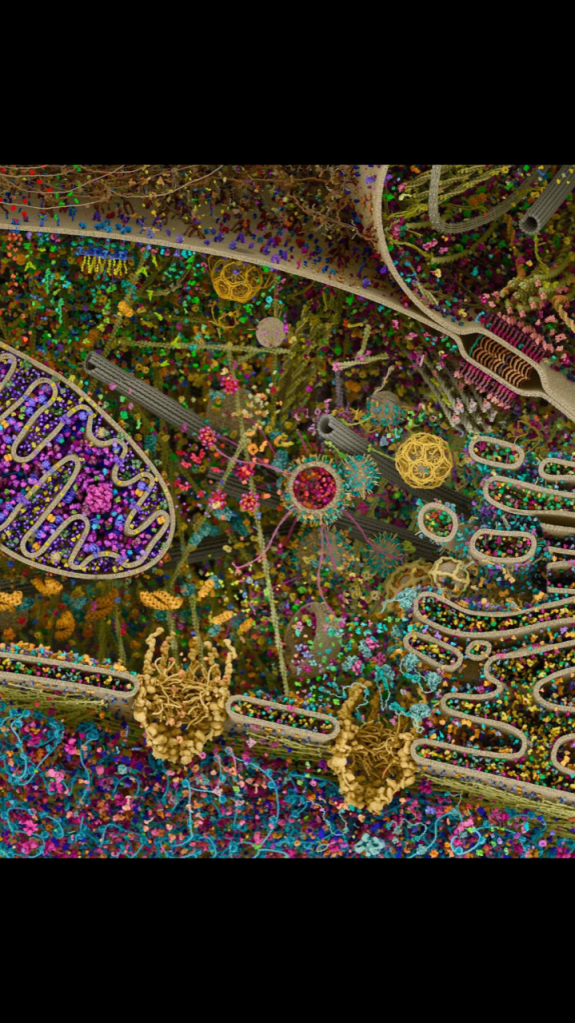
Science learning wise, I remembered an amazing exhibit I went to in Chicago (2018). They had a fully sculpted basement where you explored the ‘world of soil’ as an ant. Way more informative and fun.
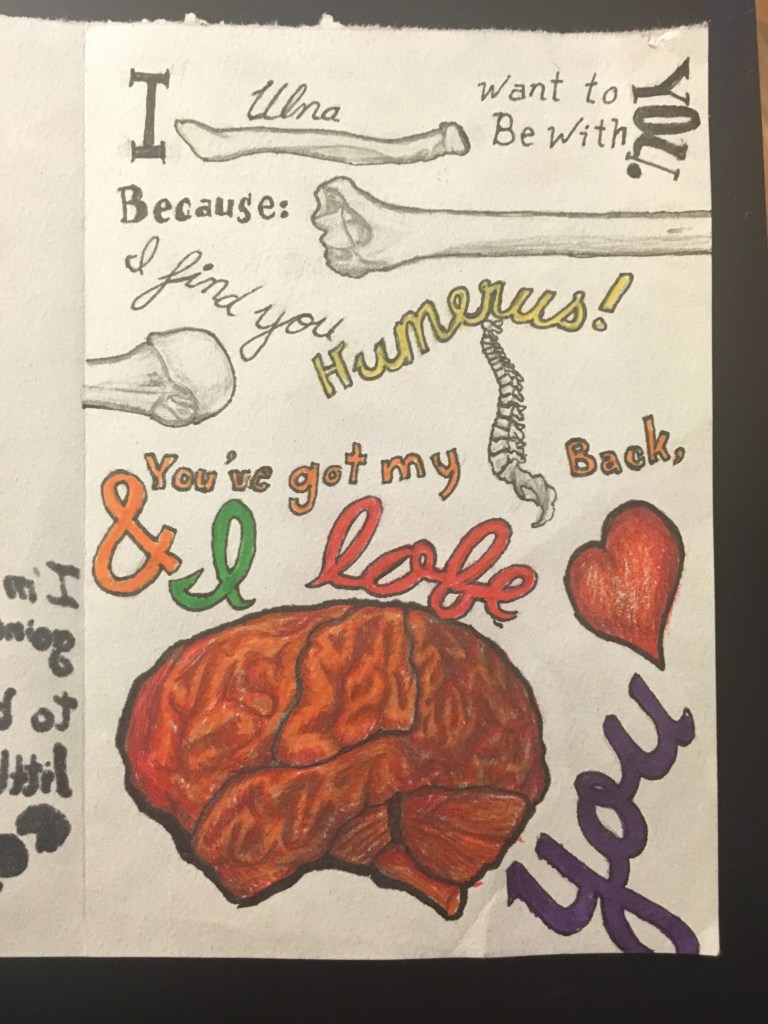
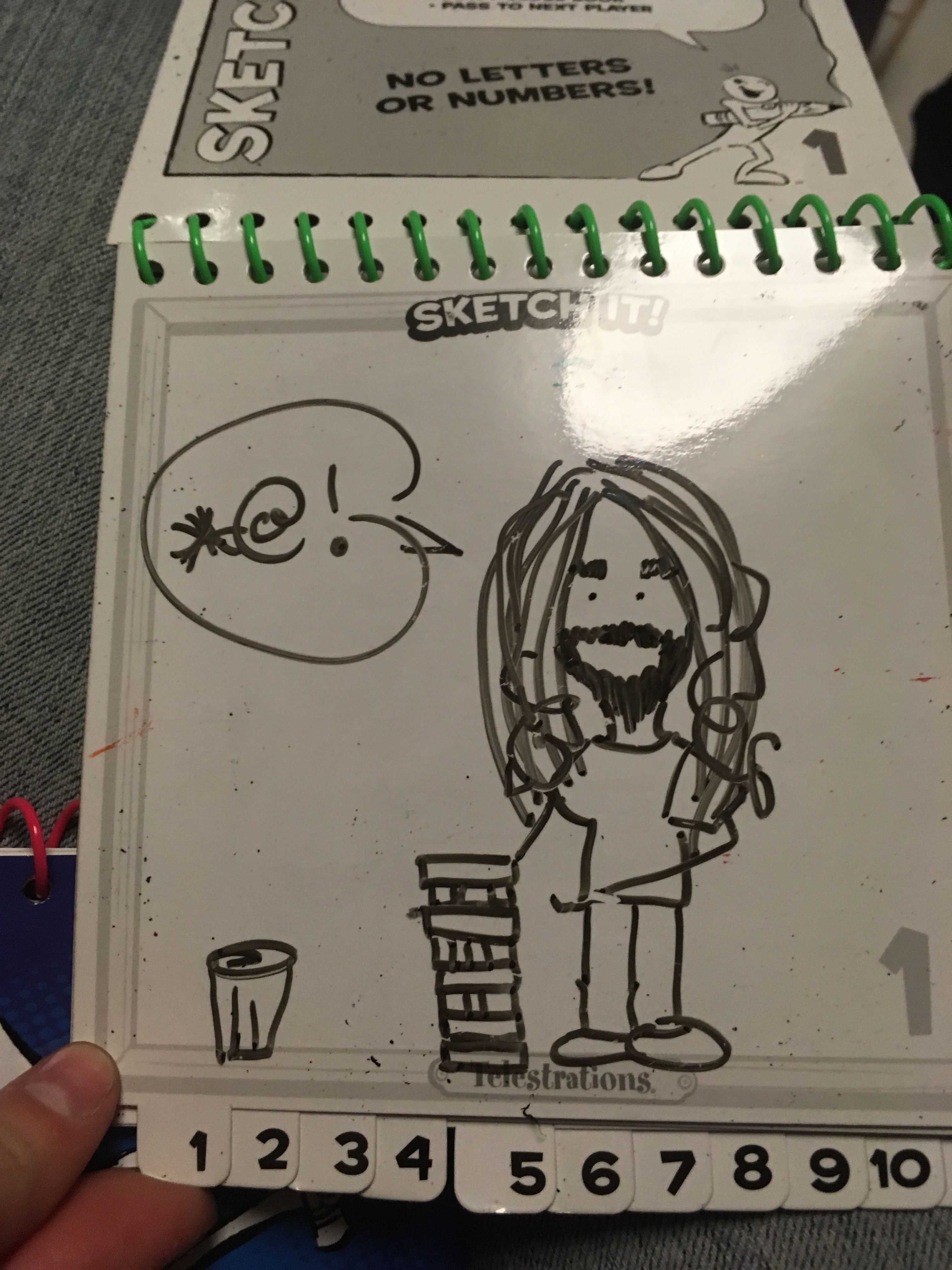
I also got to look back at some of the ‘cheesy silly’ things I’ve done in the past through a new lens. I’m actually pretty proud of this card, and my anatomical knowledge definitely helped support my weaker drawing skills.
I think making punny cards could be a good classroom activity!
I decided to try this a simply a Stream of Consciousness while reading Braiding Sweetgrass by RW Kimmerer. Rather than dwelling in the structure and meaning of my entry I’m going to instead focus simply on the stories shared and my responding to them as they come.
During my reading I felt a strong connection between both the 4Rs youth movement and Young’s Dis/Abilities paper. Both focus on developing critical literacy, though 4Rs is less explicit about this, and social activism in young people, though they have different focuses. Young focuses on dis/abilities and heterosexism whereas the 4Rs approach comes from the side of reconciliation. However, both appear to come to the conclusion that individual identity, safe environment, and meaningful communication are preqrequisites to meaningful social and crucial discourse.
Young focuses on developing the abilities of decoding language and message, connecting language and power, and critical analysis. The 4Rs focus on supporting introspection and self-evaluation in all students, guided and safe conversations, and “third thing”.
4Rs is an Indigenous and non-Indigenous youth give their perspectives, goals, and approach to reconciliation in Canada and social activism. Such a difficult topic and conversation, but the content of the site alone is an amazing window into the lives young people and how they relate to such serious topics. Beyond that they have a strong focus on platform, tools, leadership, and capacity building in young people that is both powerful and inspiring. Their focus on bridging the gap in reconciliation by developing strong individual identities and ‘connected/strong?’ diversity is a new approach to me.
I enjoyed the iterative and collaborative process that they have been following, especially is they were formed through the coalition of many existing your advocacy groups which formed the bedrock of their organisation. They have a clear and concise path towards there goal, by bringing everyone together on even-footing so that balanced and open discourses can take place amongst any young people.
They make a point of mention that many schools may not have visible diversity, and yet we must welcome and learn about diversity in every classroom. They’re discussion of privilege and diversity got me thinking about the fact that we all have our own unique positionalities. We have greater and lower levels of privilege in various spheres of our lives, even just by living in a democratic and wealthy country in Canada whatever our experience in this country might be. That said, we are also all lack privilege and have negative experiences as well. Especially in Saskatchewan there can be a disconnect from messages of anti-racism and critical discourse towards our colonially educated students. Through introspection and careful but difficult conversations we can support our students to bridge that disconnect as individuals and together.
This focus on looking inward and calm contemplation as a precursor to cross-cultural connection and critical analysis reminds me of a meditation initiative in California. The school started opening and closing everyday with 12 minutes of unguided meditation (after teaching the skill) in all classrooms. They found a great improvement in classroom management, attendance, and student achievement simply through giving students time to stop and breathe. Giving the space to simply be in their bodies as individuals and feel their own thoughts was apparently powerful in their school experiences.
I’ve been inconsistently dipping my own toes into meditation in the last few years and I definitely find it valuable. Again, it doesn’t always feel important or worthwhile when there’s so much going on, but I’m always happy when I do do it. Personally, I found that just listening the thoughts that arise without immediately assessing and addressing helped untangle my thoughts. Afterwards, I would feel both clearer mentally with a path ahead, but also physically calmer even when I hadn’t realised that stress had keyed me up.
I guess where I’m going with this is that I think many of us are disconnected from ourselves. We often don’t value ourselves as beings of body and spirit but rather solely for our contributions. In my experience, our society disregards the personal (identity, feelings, beliefs, hopes) in favour of the public (money, beauty, function, service). Its no surprise that when we don’t often consider our own selves as feeling, wishing, and hurting beings that its difficult to authentically do the same to others.
Going forward, I hope to try and integrate these strategies and values into my own practice for both my and my students’ development.
Datta is a really powerful writer, in an unassuming way. Much of his work is quite humble and the content is easy to comprehend. His paper on the community garden first interested me simply because of the environmental and local community connection it had but I soon found much more.
Firstly, his discussion of his own identity of an Indigenous Bengali man was eye-opening. Indigenous people all over the world face difficulties, but they also have great community and culture that we can learn from. Somehow hearing about his past opened my eyes beyond the story of the ‘annihilated and limping’ indigenous cultures living on life-support to look at the actual culture and people as a whole unto themselves.
Not to say that Canadian FNIM people are not struggling or that there are no impacts today, but rather that there are two stories happening here. One of the assault on FNIM communities and culture, and the second the story of those FNIM communities and cultures independent of outsiders’ interference.
His work also expanded my concept of ‘research’ by introducing me to the Participatory Action Research method which sets out to understand the supposedly ‘unquantifiable’. He sought to see sustainability through the lenses of the community gardeners. Datta did this by engaging and sharing in cultural stories, activities, music, and foods at the garden including sharing his own. I was impressed by how much he was able to learn about or ‘find out’ about sustainability and cross-cultural connection through this endeavor.
I personally surprised by how much more invested I felt in the paper just because it was local to me. In a way it relieved me of the burden of interpolating it to my experiences. I wasn’t stuck thinking ‘would that even work here?’, ‘that’s impossible because of our local environmental limitations’ and ‘Saskatchewan isn’t interested in these topics’ that I normally do with other social or environmental papers. But there really is wonderful things all around us at all times of year.
So often in both biology and education I’ve felt some options were not accessible to me because we don’t have enough people, we don’t have a warm enough climate, or some other thing but apparently that’s not true. This allow gave me the impetus to reassess some of my assumptions of my own life and home.
I think that following the strict definitions of ‘experts’, ‘knowledge’ and ‘truth’ that I’ve been brought up I limit both myself and my future students. Datta’s research does not fit into that model exactly, though it is still quite academically rigorous, and yet I learned so much from it. I’m excited to broaden my learning horizons to new people and to catch up on all that I’ve been missing.
From my own experiences, courses, and the readings I have a sense that the FNIM world-sphere has a greater appreciation for ‘non-traditional’ academic endeavors. I want to deepen my relationship ship with visual art both for my own piece of mind and for the sake of my future students. Knowledge itself is not attached to the written word as much as we may feel it is tied up in books. Students have all kinds of interests, experiences, and talents that they can use to interact with the world and express themselves.
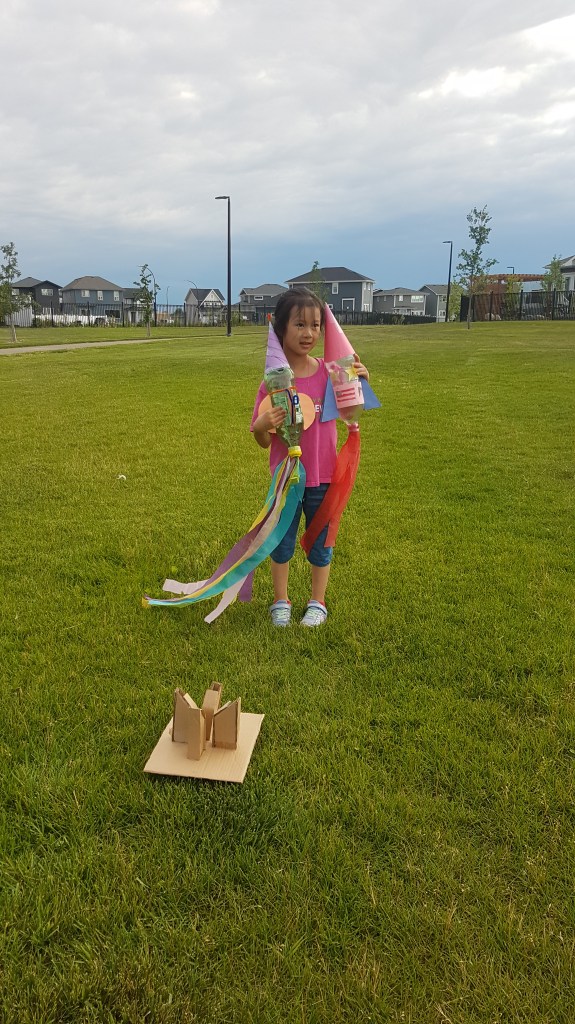
My niece with the bottle rocket we all made together.
We learned a lot about water pressure, when paper gets wet, picking up all of our garbage.
It was also fun watching the adults fuss over the little aerodynamic details of a hot glued bottle rocket.
She really enjoyed the decorating the most though!
Even in the working world I’ve found that little actually decision-making or problem-solving is done wholly through numeric analysis, even if only through additional oral discussion. There’s always interceding factors, relationships and more that influence, synergize/empower, and circumvent cold analysis. This is beneficial to businesses, employees, and the world because it is more flexible and responsive. Otherwise computers would be better at predicting climate, investments, and crime than they are now. Beyond that though, work isn’t/shouldn’t be the most important thing in anyone’s life, and personal lives rarely rely on cold hard facts if ever. Even financial decisions require judging the validity of information and predicting the future stability of non-monetary factors.
All this is to say, that while cold hard facts can be powerful, they are useless on their own and often not actually applicable at all when it really matters. I think it is important to be informed but as this year has shown us, we are still led by our heart more than information we’ve gotten from the ‘information age’.
I feel like my own culture, colonial European culture, has left behind lots of its traditional and aesthetic pursuits while running in the global rat race. For this reason, I’m hoping to learn more from other cultures, especially Canadian Indigenous cultures, about the role are can play in our lives and in our learning.
Through reading selection options, I developed my own personal goals. I think it consolidated many thoughts and concerns that I’d been having through my education school career but hadn’t had the time to explore in depth. I surprised myself with how clear and motivating I found my guiding principles. A broader appreciation of knowledge and expression supports connection.
I also clearly felt my own discomfort in these spaces, like I’d walked in on someone else’s family dinner. I felt that there was something wonderful and special there but at the same time I felt both and urge and push to leave? This isn’t something I fully understand myself, but its strength makes me thinks its something important to explore deeper. Personally, I don’t want to be beholden by an impulse that I don’t understand, trust, or know the source of, especially since it doesn’t seem to be serving any helpful purpose.
I think I have a blind spot and bias against the ‘unquantifiable’, that if it cannot be measured that it cannot be relied on and is therefore useless. I know conceptually that none of that is true or even accurate, many complicated and human things can be measured and many ‘facts’ are not measured honestly, this is simply a bias I’ve allowed to go unchecked.
In part I think this is defensive, this isn’t a part of myself that I’ve ever explored despite my personal interest because I didn’t feel it was acceptable or valuable to do so. I resented past experiences where, as a student especially, the message was to be creative but the reality was that your options were to slap paint on a pig (colour strict academic product), create a masterpiece taking many hours beyond the scope of the activity which ‘earned’ its right to be assessed as learning, or try and fail receiving comments that this creative endeavor doesn’t actually do what an essay would have done and therefore is useless.
To be frank, looking back, I’m not sure how many of these messages were even explicit or intentional. Maybe my own insecurity in my abilities read to far into the comments I received. Maybe my message was confused regardless of the creative liberties taken. But I sure that no major assessments or learning were done without concrete work shown on loose-leaf.


 Baumann Teaching